
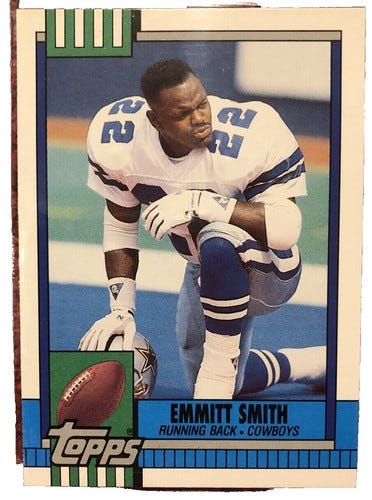
It started with an Emmitt Smith rookie card.
I was a kid in the early nineties, pocket money burning through my jeans, and the moment that card was in my hands I needed to know everything—print runs, condition grading, which sets were worth chasing, which dealers could be trusted. I pored through every Beckett price guide I could get my hands on, dog-earing pages, cross-referencing values, learning to read the market the way other kids read box scores. Within months I had binders, a mental index of the hobby that my friends found baffling and I found completely natural. I was not collecting football cards. I was building a system around football cards. The distinction, I would eventually understand, mattered.
Thirty-some years later, I own a watch collection tracked across a detailed spreadsheet, organized by complication and tier, with an acquisition roadmap that extends to 2053. My bourbon shelf has its own document. My records live on Discogs and in supplementary notes. My books have a Goodreads profile and, yes, additional context that most people would consider unnecessary. Cigars have recently entered the picture. Knives and EDC are never entirely dormant. I have been through phases of deep engagement with sport cards, gaming and tech, audio gear, cycling, fitness equipment, clothing and an ever-expanding shoe and boot collection. Each time, without exception, the pattern has been the same: find the interest, go all the way in, build the system, accumulate the knowledge. The objects have changed—a two-dollar card became a three-thousand-dollar watch, a pack of cards became a two-hundred-dollar bottle of bourbon—but the disposition driving the pursuit has not changed at all.
I used to wonder, occasionally, whether this was a character flaw. It is not. It is a methodology. And I have come to believe it produces something that more casual engagement simply cannot: genuine depth, and the particular satisfaction that comes only from knowing a subject on its own terms.
The Pattern Reveals Itself
When you have lived the same pattern enough times, you start to recognize it early. There is an initial encounter with something—a card, a piece of gear, an album, a watch in a shop window—that produces a specific quality of attention. Not just interest. Something closer to recognition. The mind leans in and does not lean back out.
What follows is research. Always research. Forums, books, communities of people who have been at it longer. The vocabulary of the domain—because every serious pursuit has one—gets absorbed quickly, because the vocabulary is the map of what matters. In cycling, you learn the difference between a training build and a race build, what a particular groupset signals about a bike’s intended use, why frame material is a more complex question than it first appears. In audio, you learn about impedance matching, the audible differences between cartridge types, why the pressing matters as much as the recording. In knives and EDC, you develop opinions about steel composition and heat treatment that would have seemed absurd to you six months earlier.
None of this knowledge is wasted, even when the phase passes. And some phases do pass—the cycling gear has been through several iterations, the gym equipment has had its quiet periods, the shoe and boot collection expanded and contracted over the years before settling into something more considered. But the knowledge compounds across domains in ways that are difficult to predict and consistently rewarding. Understanding why quality construction matters in a boot turns out to be excellent preparation for understanding why it matters in a watch. Learning to evaluate a record pressing teaches you something about evaluating any object where provenance and condition affect the experience of ownership.
The cycle itself has a reliable shape. It begins with a casual entry—something inexpensive that satisfies the initial burn of curiosity without overcommitting. From there, each piece or component gets evaluated and, where it falls short, upgraded. Systematically, deliberately, one informed step at a time, until either the collection reaches a natural end state or the intensity of interest cools. And when it cools, it rarely disappears entirely. It waits. Months later, sometimes years later, something reignites it—a conversation, an object encountered by chance, a gap in the collection that suddenly becomes impossible to ignore—and the whole machinery starts again, but now with the accumulated knowledge of the previous run behind it. Each cycle leaves the collection and the collector better than it found them.
The Case for Going Deep
There is a common argument for breadth—try many things, stay light, keep options open. It has merit. But it produces a particular kind of collector and a particular kind of experience: wide, entertaining, and ultimately shallow. The person who has dabbled in watches knows some brand names and a few reference numbers. The person who has spent years moving deliberately through tiers, reading the history, wearing the pieces, understanding the movement architecture, knows something categorically different. They have developed taste, and taste—real taste, earned rather than borrowed—changes the experience of ownership entirely.
This is the wisdom in going deep: the object and the knowledge of the object become inseparable. A bourbon is not just a bourbon when you understand its mash bill, its distillery’s history, where it sits in the continuum of what that producer has made. A record is not just an album when you know the pressing, the engineers involved, why this particular version sounds different from the reissue. The depth of knowledge does not complicate the enjoyment. It amplifies it.
There is also a practical argument. Depth protects you from the market. The collector who has done the work is not easily oversold. They know what something is actually worth, what alternatives exist at the same price point, where the genuine value lies versus where it is manufactured by hype. In watches, in bourbon, in records, in sport cards—every category has its mythology and its noise. Knowledge is the filter.
Why Incrementalism Is the Only Way In
Depth cannot be purchased in a single transaction. This is the part that resists the shortcut. You can buy an expensive watch without understanding watchmaking. You can buy a celebrated bourbon without having developed a palate. You can acquire a first pressing without knowing why it matters. The object arrives, but the knowledge does not come with it, and without the knowledge, you are holding something whose value you cannot fully access.
Incrementalism solves this. Moving through a domain in deliberate steps—spending real time at each level before ascending to the next—builds the knowledge alongside the collection. The entry-level piece teaches you what to look for in the mid-tier piece. The mid-tier piece gives you the context to evaluate the serious piece. By the time you are making a significant acquisition, you are not guessing. You have a considered position, earned through attention and patience.
My watch roadmap runs to 2053 not because I am a patient man by nature—I am not, particularly—but because I understand that the pieces at the end of that timeline will mean more when I reach them having done the work. The grail watch in a collection built from the ground up is a different object than the same watch purchased cold. The journey is not incidental to the destination. It is the reason the destination matters.
From Two Dollars to Two Thousand: The Evolution of Stakes
One thing changes as the methodology matures: the caliber of what it targets. The two-dollar football card was the right entry point for a kid with pocket money and an forming sensibility. It was not a compromise—it was the appropriate first step. But the knowledge that accumulates over years of serious collecting has a natural consequence: it raises the bar. Once you understand what genuine quality looks like, what separates a well-made object from a merely adequate one, it becomes increasingly difficult to settle for the adequate. The stakes evolve because the eye evolves.
The watches on my roadmap are not expensive because expense is the point. They are expensive because, at a certain level of craft, expense becomes the honest reflection of what went into the object—the movement finishing, the case work, the decades of horological tradition behind a caliber. The bottles on my bourbon shelf that carry real price tags carry them because the liquid inside is the product of time, grain, and genuine distilling knowledge that cannot be faked or rushed. The methodology gravitates toward quality not as status but as substance.
Alongside the evolution in stakes has come an increasingly specific set of preferences: a pull toward objects with genuine history behind them, toward things made by hand rather than at scale, toward editions that exist in limited numbers for considered reasons rather than manufactured scarcity. A limited production watch from an independent maker carries a different kind of meaning than a mass-market piece at the same price. A small-batch bourbon from a distillery with a real story behind it sits differently on the shelf than an allocated release chased purely for resale value. The provenance is not incidental. It is part of what is being collected.
Last December, I placed an order for my first pair of Beckett Simonon shoes—a wholecut in Italian leather, made to order, the kind of thing that requires patience before it even ships. They have not arrived yet. But the research that preceded that order was anything but casual. Before I even settled on a maker, I found myself deep in the long-running debate that serious shoe collectors know well: Goodyear welt versus Blake stitch. On the surface, it is a question of construction—how the upper, insole, and outsole are joined together. In practice, it determines everything from repairability and longevity to how the shoe feels underfoot as it breaks in, how water-resistant it is, how it will age over decades of wear. A Goodyear welted shoe can be resoled repeatedly and will last a lifetime with proper care. A Blake stitched shoe is more flexible from the first wear, slimmer in profile, with a different aesthetic logic entirely. These are not trivial distinctions. They are the difference between buying a shoe and understanding what a shoe can be. By the time I had made my decision, I had not just chosen a pair of shoes. I had developed a working knowledge of craft footwear construction that will inform every shoe purchase I make from here on. That is the methodology at work. And yes, they will be well worth the wait.
Where the Methodology Lives Now
The current expression of this pattern runs across several domains simultaneously, which is either impressive or alarming depending on your disposition. Watches, bourbon, records, and books carry the most weight right now—each tracked, each researched, each building toward something more considered than where it started. Cigars have recently joined the rotation, already with a 33-litre humidity-controlled cabinet fitted with Spanish cedar drawers and a digital hygrometer, because of course they have. The knife collection, never entirely at rest, is stirring again. The shoe and boot collection continues to grow with the same deliberate attention applied everywhere else.
The watch collection has its taxonomy and its roadmap. The bourbon shelf has its spreadsheet and its reading list of distillery histories. The records live on Discogs, where the platform’s insistence on specific pressings and matrix details enforces exactly the kind of precision this methodology demands. The books have Goodreads and supplementary notes on editions, context, and how each title connects to others in the library.
These are not separate hobbies running in parallel. They are simultaneous expressions of a single habit of mind—the same one that produced the binders of football cards in the nineties, the meticulous gear lists in other phases, the obsessive research that preceded every significant acquisition in between. The hobby changes. The methodology does not.
What a Lifetime of This Actually Produces
After three decades of this pattern across a dozen domains, what accumulates is not primarily a collection of objects. It is a cultivated sensibility—a finely developed ability to recognize quality, understand context, and engage with the things you love on their own terms. The objects are evidence of the sensibility. The spreadsheets are the working notes. The sensibility itself is the thing of value.
That sensibility transfers. Someone who has gone deep in one domain and developed genuine taste there carries something applicable everywhere: the habit of asking what makes something good rather than merely desirable, the patience to find out, the discipline to let the answer guide the decision. It is a way of paying attention, and it improves with practice.
There is also, I will admit, a quieter reward. The person who has done the work—who has read the history, worn the pieces, tasted the range, listened to the pressings—enjoys their collection differently. Not with the anxiety of the speculator or the restlessness of the dilettante, but with the settled pleasure of someone who knows exactly what they have and why they have it. That quality of enjoyment does not come from spending more. It comes from knowing more. And knowing more is always, in every domain, a matter of time and attention.
The Only Advice Worth Giving
If there is a practical takeaway in any of this, it is not a system to copy or a spreadsheet template to download. It is simpler and harder than that: when something earns your genuine interest, take it seriously. Do the reading. Build the vocabulary. Move through it deliberately rather than rushing to the destination. The depth you develop will outlast any individual acquisition, and it will make every acquisition more meaningful.
Right now, there is a glass of something considered on the desk beside me, a turntable working through an album I have been anticipating for weeks, a book open to a page I have been meaning to reach, and a watch on my wrist chosen with more confidence than I could have managed ten years ago. The roadmap runs to 2053. It started with a football card in the nineties.
None of it arrived at once. All of it was worth the wait.
— Jaime