
I want to tell you about the Apple Watch Ultra 2. Not because it was a bad device. It wasn’t. It was the best version of what it was trying to be: titanium case, satellite communication, more data and sensors than most people know what to do with. I tracked my steps, my ECG, my compass heading, my sleep, my recovery score, my heart rate zones during every session. I upgraded from the standard Apple Watch to the Ultra, then to the Ultra 2, because I needed the best version of the thing I had decided mattered. I thought about what would happen if I was lost on a mountain and needed satellite rescue.
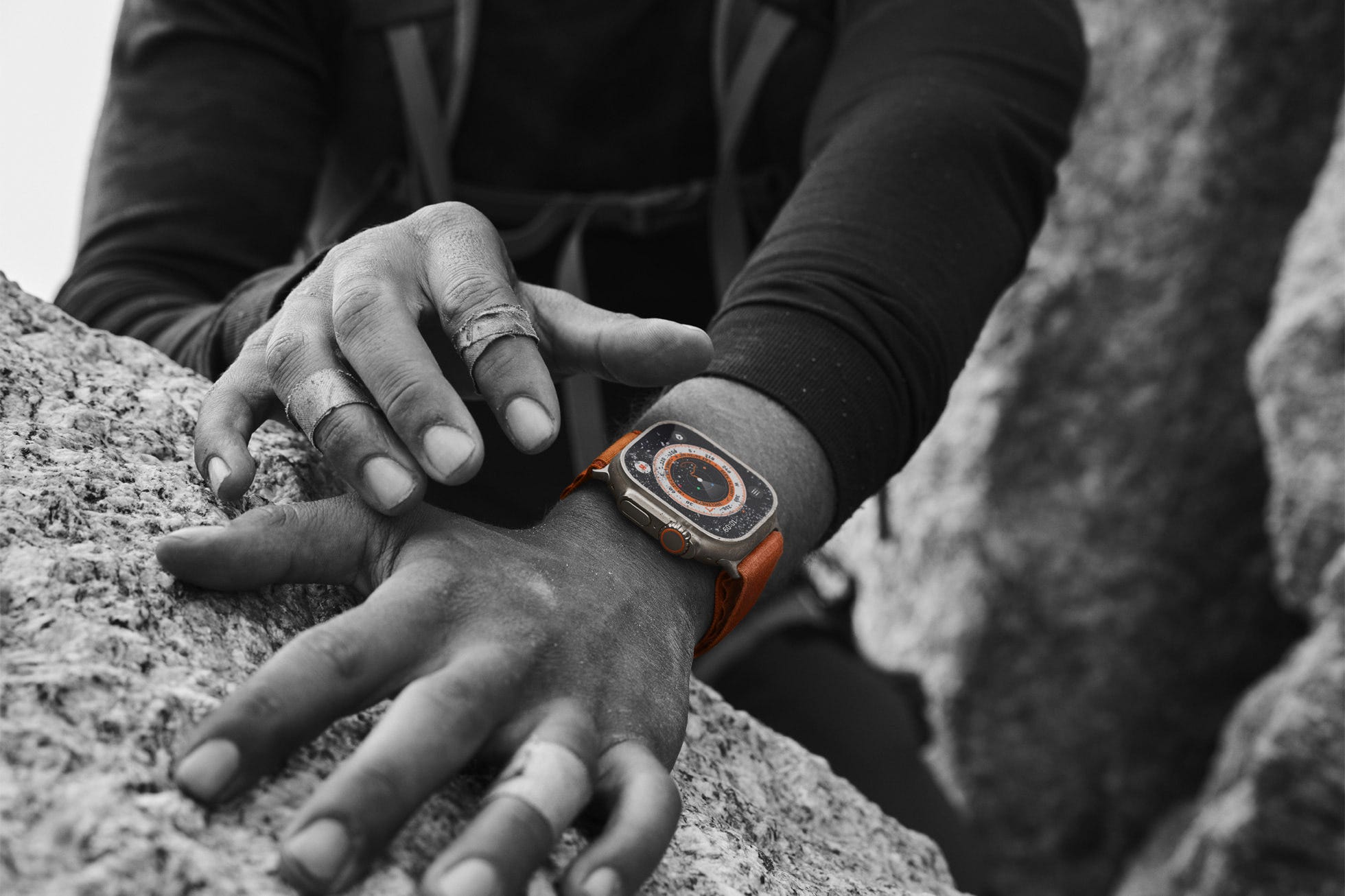
I live in Tampa. I am not a mountain person. I have never once been in a situation that required satellite communication to resolve but I thought about it. That’s the kind of collector I am. When something earns my attention, it earns all of it. “All In” is the essay about that pattern. The Emmitt Smith rookie card, the cycling gear, the audio equipment. Every domain gets the same treatment. Find the thing, go completely inside it, build the system, know everything there is to know. The Apple Watch Ultra 2 was the fitness phase in its fullest expression. The system was a house of cards.
After five days a week in the weight room lifting and five days a week of taekwondo training for months, something had to give. I had my supplements set, workout logs. meals prepped, protein shakes, and recovery tracking to a tee. Every metric feeding every other metric, the whole thing balanced on the assumption that the body would keep cooperating. It felt like the ultimate in discipline. A knee injury put a damper on all that and I lost my momentum.
I stopped lifting, stopped logging workouts, stopped taking supplements and stopped tracking everything the watch existed to track. The house of cards came down at once and the Ultra 2 sat on the charger.
Into that silence came something I hadn’t planned for.
My twin sons, Jansen and Vaughan, turn 19 in September. In 2025, on their 18th birthday, I bought them each a Citizen Eco-Drive, had them engraved, tracked the shipping the way you track something you’re genuinely nervous about. The watches arrived at 38mm.
I didn’t have the vocabulary yet for what I was feeling when I opened the box. I just knew something was wrong. The cases were smaller than I’d imagined on their wrists. I started researching: case diameters, lug widths, how proportions shift between a photograph and an actual wrist. On the morning of their birthday I found three Citizen Promaster Airs on Costco same-day delivery and bought all three.
My father wears a Citizen. Has for years. I thought they were good watches, and they are for the price. Solid movements, honest value, exactly what they promise. But I was already feeling something the Promaster couldn’t answer. A few weeks later I walked into Mayors in Orlando with Chrissy, ready to spend $800 on a Tissot PRX.
I need to be honest about the PRX. It was the most talked-about watch in the hobby when I started paying attention. I convinced myself I needed it. Not because I’d developed the eye for what made it compelling, but because the conversation around it was loud enough to sound like consensus. That’s hype doing what hype does. I walked into Mayors believing I had a considered opinion.
I found a salesman. Asked about the Tissot watches. He looked past me. Not at me. Past me, toward the door, the window, anywhere that wasn’t the conversation happening directly in front of him. He said, “You need to go to Bloomingdales for that.” I was standing over the IWC case when he said it. He looked at me and made a calculation in about three seconds and acted on it without asking a single question. Not what I was looking for. Not my budget. Not why I’d walked in that day. Just pointed me toward the door.
Chrissy and I walked out and didn’t go back.
Bloomingdales was right there in the same mall. I went. Found the Tissot case. Put the ice blue PRX on my wrist. But the display case was worn and shabby, the kind of presentation that tells you the retailer doesn’t believe in what it’s selling. I was still too raw from being dismissed twenty minutes earlier to buy anything at all. I left empty-handed.
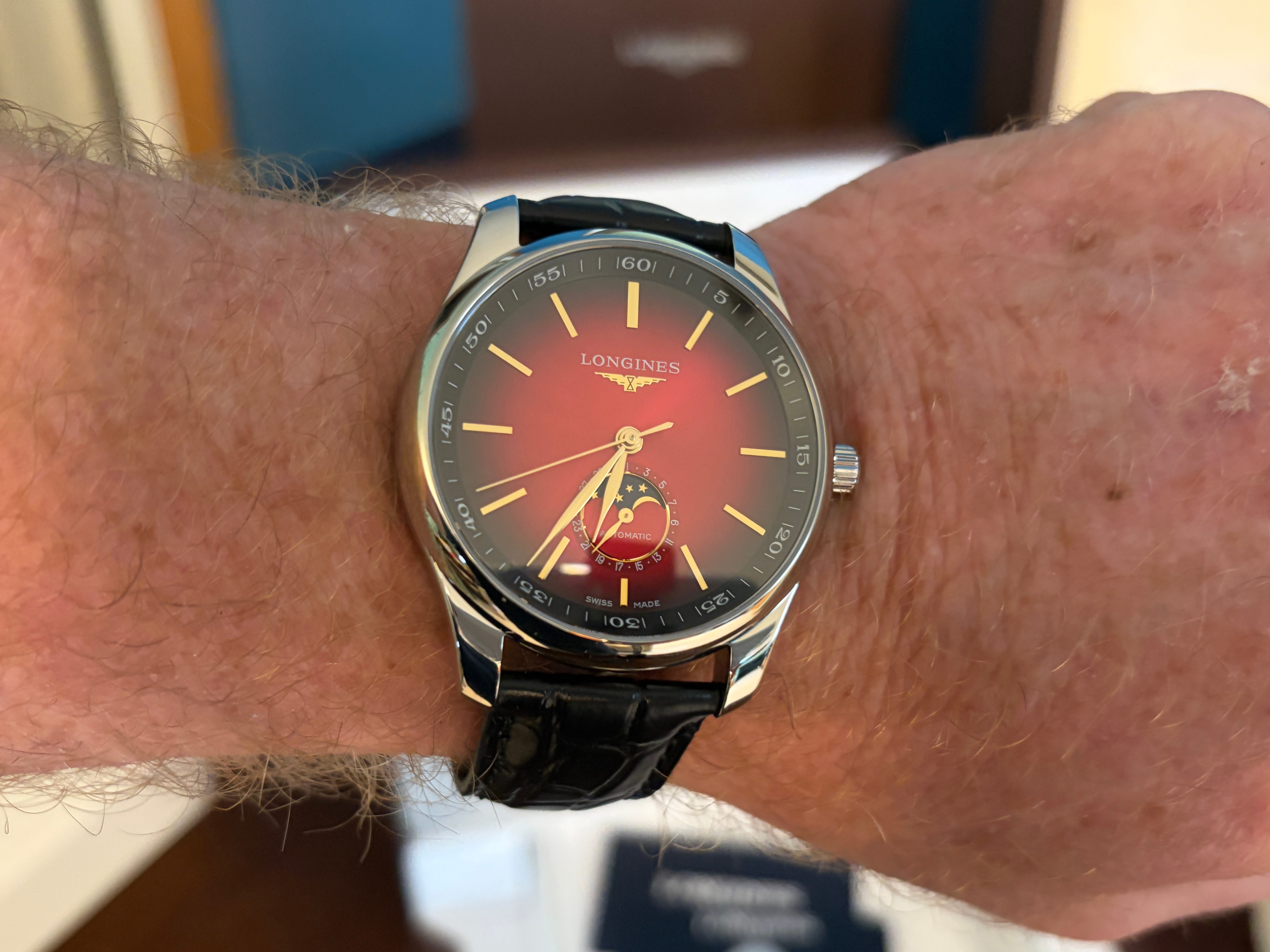
What I did instead was spend nearly four times the price of that PRX on a Longines Master Collection Year of the Horse, a limited edition with the year of my birth rendered in the dial, acquired through Bucherer’s website without setting foot in a store.
I have worn that watch three times. Each occasion earned it. I don’t reach for it casually and I never will. There are watches in this collection I wear to the job site and watches I wear to dinner and one watch I wear when the moment is rare enough to deserve it. The Longines is that watch. It showed me something no amount of research had managed to show me: the distance between good and excellent. The movement finishing. The weight of decisions made by people who considered everything. Good watches tell time. Excellent watches tell you something about what went into them.
I had spent weeks reading about case diameters and water resistance ratings. The Longines was the first time I understood I’d been studying the map without ever seeing the territory.
The collection started the day I understood the difference.
I’ve spent 24 years in construction. Historical restoration mostly: buildings designed before planned obsolescence was a business model, structures that assumed someone would still care about them a century later. I know the difference between a foundation poured to last and one poured to pass inspection. That difference is invisible right up until it isn’t.
A mechanical watch is the same argument in miniature. No battery degrading on a schedule someone else set. No software update that makes last year’s model insufficient. No annual release cycle engineered to make what you’re wearing feel inadequate. A movement running on physics, serviceable, repairable, passing from one wrist to the next with nothing lost but the original owner’s fingerprints.
The Apple Watch Ultra 2 will be landfill inside a decade. The Bulova I bought at 27 is going in for its first service now, twenty years later. Not replacement. Service. The distinction is the whole point.
I’m almost 50. My parents are in their 80s. I don’t know if what shifted in me was contemplating my own mortality or simply a man arriving at a hobby suited to the person he was becoming, someone who builds things meant to outlast the moment, who understands at a bone level that the enemy isn’t a particular brand or price point but planned obsolescence itself. Probably both. I’m honest enough to say I’m not entirely sure, and that uncertainty feels like the most truthful thing I can offer.
What I know is this: I stopped tracking mountains I wasn’t climbing and started paying attention to what I actually wanted to leave behind.
My sons won’t need to buy watches when they’re older. That’s the plan stated plainly. I’m building collections for them in real time, birthday, Christmas, graduation, the occasions that come around reliably if you’re paying attention. They don’t fully appreciate it yet. That’s fine. The collection is already theirs. It’s just still arriving.
Every watch in this collection has a story I wrote myself. Not the brand’s story, not the reference history, not the secondary market narrative. Mine. The $13 Casio has been correct about the time every single day for nearly a decade without being asked to try. The Bulova I bought at 27 because I wanted to look like someone who had his life together is heading in for its first service, still running perfectly, outlasting the reasons I bought it. Seventy-two doors. Each one opens somewhere specific.
Which brings me back to the PRX. It never fully left my peripheral vision after that Sunday at Mayors. It kept reappearing: different iterations, different contexts, never quite finding the right moment. A green dial quartz that lost its slot to a stronger argument. A leather strap Powermatic 80 on Jomashop that disappeared into a ten-week backorder before I could complete the purchase. Each time I passed on it I was refining what the yes would actually look like.
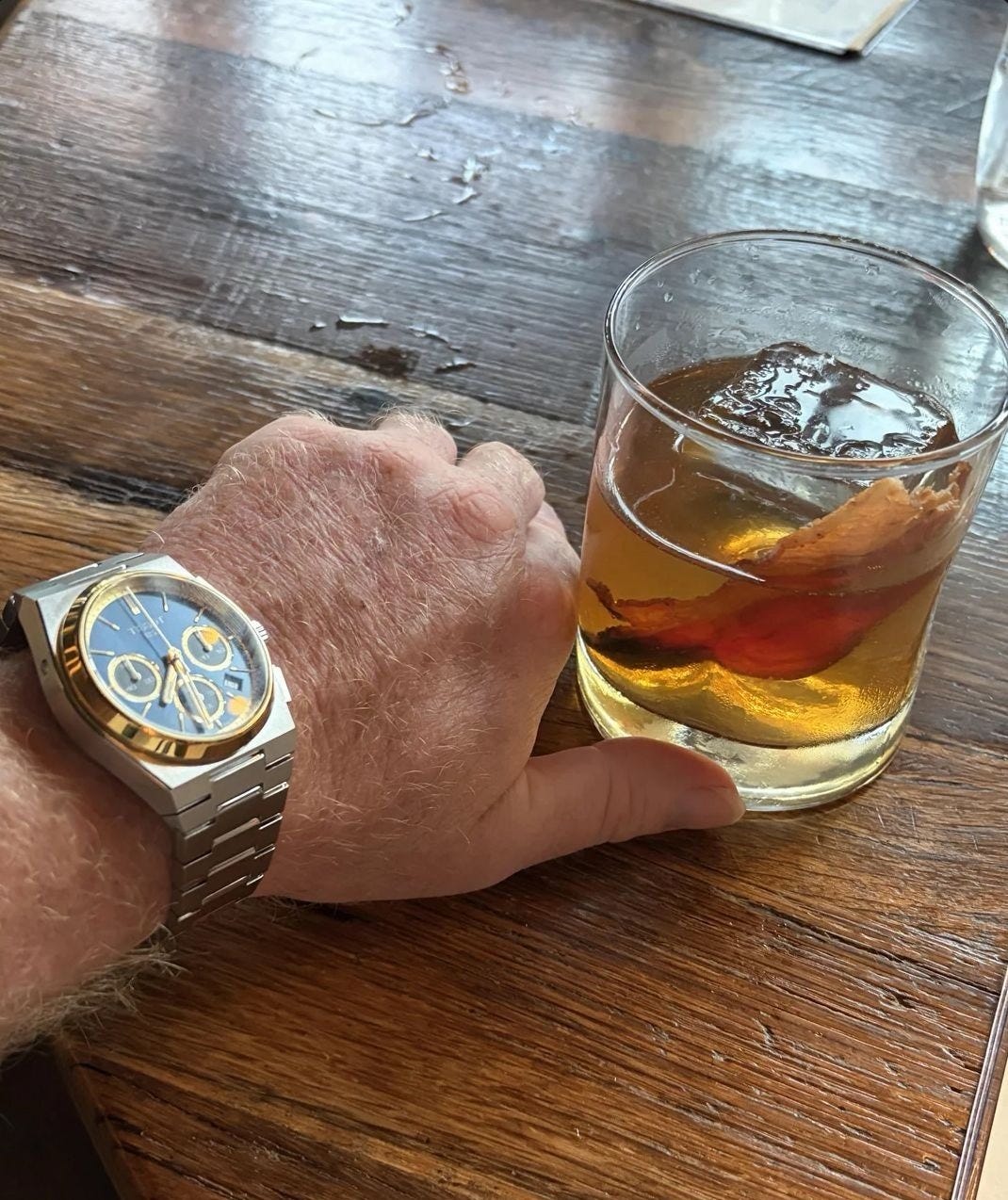
It arrived as the Tissot PRX Automatic Chronograph Limited Edition at Bucherer. T137.427.21.041.00. Limited to 1,888 pieces. The number references Bucherer’s founding year, which means something in context and is the kind of detail I’ve learned to recognize as genuine rather than manufactured. Blue sunburst dial. Three black chronograph subdials. Yellow gold PVD bezel ring that warms the whole piece without announcing itself. $2,250, the most expensive PRX in production, and the right version of a watch I’d been in conversation with for months.
The SA at Mayors made an assumption in three seconds and acted on it. That assumption cost him the sale and every sale after it. A roadmap that extends to 2048, a relationship worth considerably more than the $800 I walked in ready to spend. It sent me out the door and pointed me, eventually, toward a counter that understood where this collection is heading.
I walked into Mayors convinced I needed a watch the hobby had told me to want. I walked out empty-handed and ended up building the eye to know the difference between hype and substance, between good and excellent, between a watch that tracks what you did yesterday and one that outlasts everyone in the room.
The man who got pointed to the door ended up at a counter that knew his name.
That’s not irony. That’s curation.
-Jaime
—
Precision on the wrist. Perfection in the glass. Music to feel. Stories that last.
bezelsandbourbon.com