
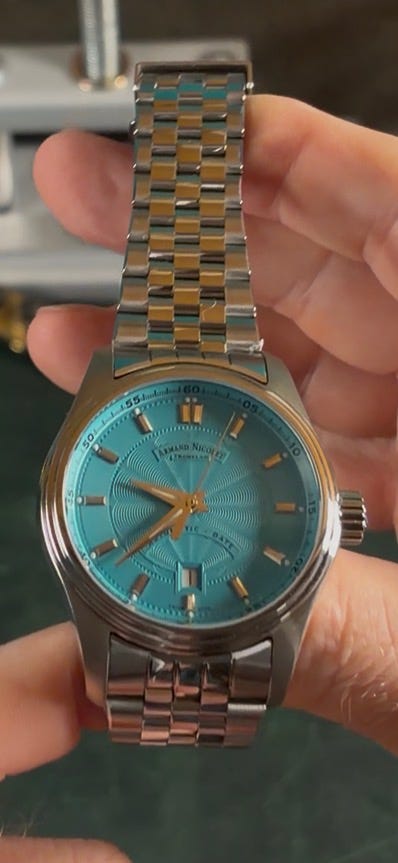
There are evenings a cruise gives you that don’t belong to any category on paper. Not formal. Not beachside. Something in between: a good dinner at a restaurant that doesn’t require a tie, a cocktail hour when the light is going gold, an evening where getting dressed meant something without meaning too much. The Mido Baroncelli owns the formal end. The Oceanevas own the water. Neither one answers the other question.
The in-between space is where the right watch earns its keep quietly. Something with enough presence to read as intentional, relaxed enough that it doesn’t own the room. A summer dress watch, in the truest sense: built for short sleeves and warm evenings, for occasions that reward thought without demanding ceremony.
That’s the gap the Armand Nicolet MH2 was bought to fill. Here’s the honest accounting of why it was acquired, what the brand is, and what the dial showed before and after wrist time settled the question.
Armand Nicolet MH2 A640A-TF-MA2640A · Acqua dial · 43mm stainless steel · ETA 2824-2 automatic · 25 jewels · 28,800 vph · 38-hour power reserve · Sapphire crystal · Exhibition caseback · 100m water resistance · Swiss Made · List $1,295 · Paid $800.36
A Watchmaker in the Bernese Jura
The origins of Armand Nicolet begin around 1875 in Tramelan, a town in the Bernese Jura. The Jura is not Geneva. It’s not the Vallée de Joux where the grand complications are born. It’s an agricultural mountain region that learned watchmaking the way it learned everything else: through patient, unhurried craft applied over generations. Armand Nicolet, son of a watchmaker, set up his Atelier d’Horlogerie after a brilliant apprenticeship, and by 1902 he had affirmed his technical maturity by producing a pocket watch with guilloché rose gold case, enamel dial, single button chronograph, complete calendar, and minute repeating function. That watch still exists. It’s in the brand’s museum in Tramelan.
When Armand died in 1939, his son Willy assumed control and developed the factory into one of the most important movement finishing operations in the region. This is the part of the story that most brand histories skip because it’s less romantic than founding myths. Armand Nicolet wasn’t making watches with their name on the dial during those decades. They were doing something more essential and less visible: finishing complicated mechanical movements for other famous Swiss brands. A genuine T1 operation. The kind of company that the watch industry depends on and almost never acknowledges.
In 1987, Willy Nicolet met by chance an Italian entrepreneur named Rolando Braga, who had been active in the watch field for two decades. Braga fell in love with the idea of recovering the extraordinary mechanical movements still held in the factory and decided to close his company in Italy and move to Switzerland. What followed was not a buyout. It was a collaboration: Swiss manufacture meeting Italian design sensibility, with production maintained at the historic Tramelan factory and a design and marketing operation established in Brescia, Italy. The technical rigor stayed in Switzerland. The aesthetic language came from Italy. The watches that emerged from that partnership don’t announce the collaboration. They wear it.
The MH2 is one of them.
MontreHeure 2: What the Name Means
MH2 stands for MontreHeure 2. The “Montre Heure” designation marks the midrange sports automatic line. The “2” doesn’t mean version two in the way consumer electronics use version numbers. It means the line evolved. Learned something from what came before it. Carried the good things forward and left the rest.
That’s a quiet kind of confidence. Not new and improved. Not a marketing refresh. Just 2. The watch that came after they understood what the first one needed to be.
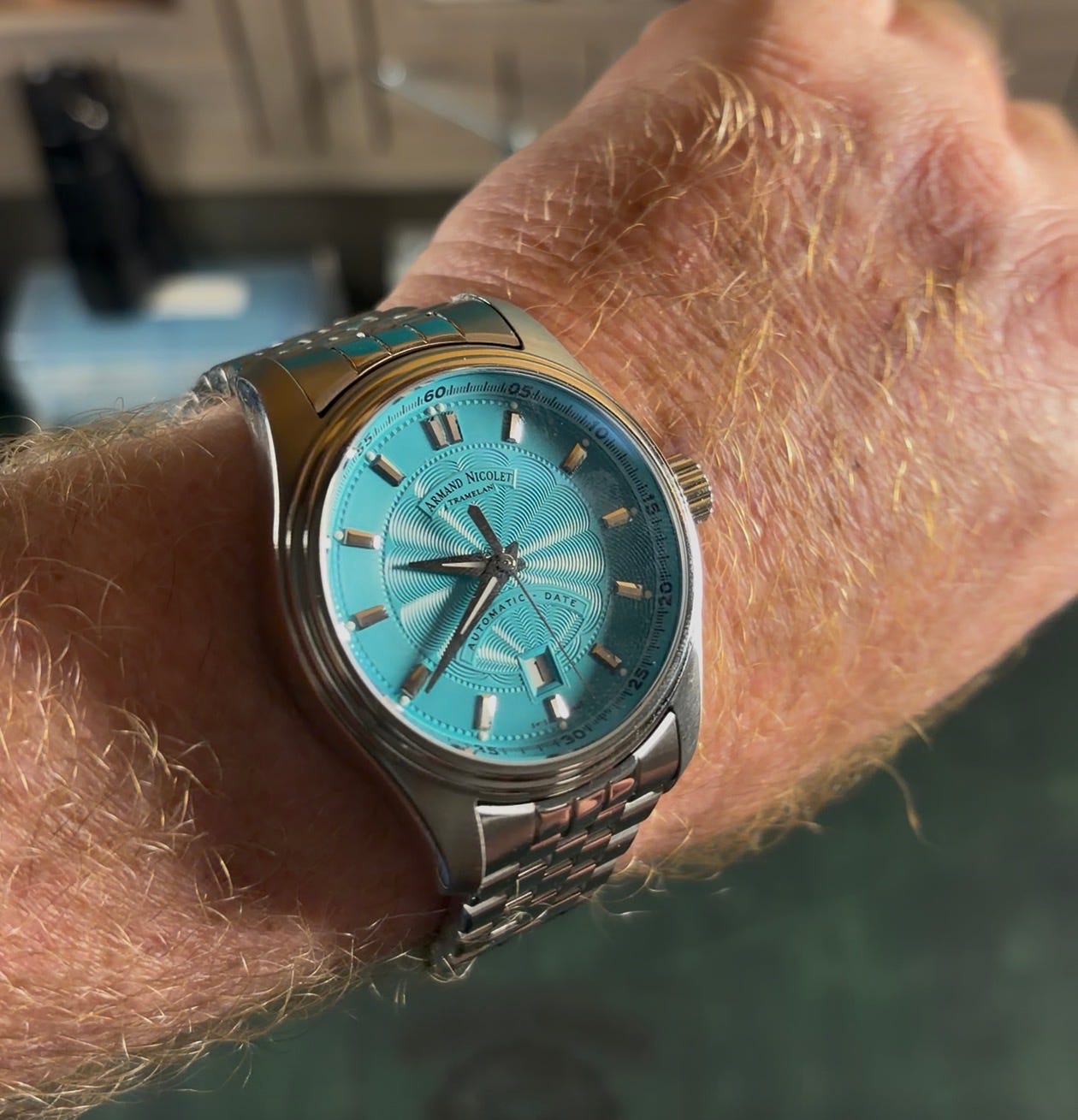
The standard MH2 A640A is a three-hand automatic. No chronograph complications, no GMT function, no date window cluttering the dial. It does one thing: tells time. The case is 43mm stainless steel throughout, no ceramic, no PVD. Sapphire crystal. Exhibition caseback. 100 meters of water resistance. What’s inside that caseback is the ETA 2824-2, which is both the least romantic detail of this watch and the most important argument for it.
The Movement Case: ETA 2824-2 and Why It’s the Right Call
The ETA 2824-2 is not exotic. It won’t earn you a paragraph in a horological journal. It’s a Swiss workhorse movement that has been running reliably inside watches at every meaningful price point for decades, regulated and fitted by whoever is casing it, and largely left alone to do its job.
For this watch, that’s exactly the right choice.
The ETA 2824-2 runs at 28,800 vibrations per hour, 25 jewels, 38-hour power reserve. It holds its regulation, doesn’t demand babying, and will still be running correctly in fifteen years if you service it. When you buy a watch with this movement at this price point, you’re not paying for movement mystique. You’re paying for what the movement gets out of the way to show you: the case work, the dial execution, the design intelligence of a Swiss-Italian partnership that has been at this since 1987.
The roadmap watches require in-house manufacture movements because the movement is part of what you’re buying at that tier. The MH2 is a discovery-lane acquisition filling a genuine gap in the rotation. For that job, a well-regulated ETA 2824-2 is not a compromise. It’s the correct specification.
The Dial: Acqua and the Guilloché Beneath It
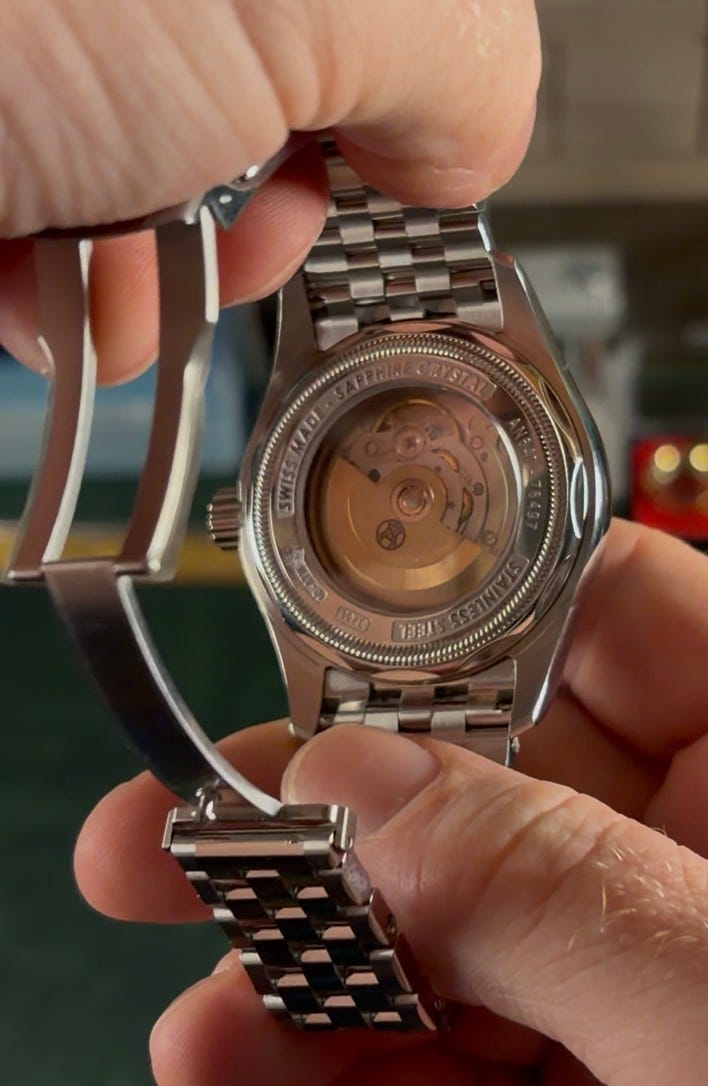
Armand Nicolet makes the MH2 in several dial colors. The acqua chose itself.
But the color is only half the story, and arguably the lesser half. Beneath the acqua finish is guilloché: an intricate hand-engraved pattern that catches light in every direction, a texture so detailed it reads differently depending on the angle, the hour, where you’re standing. Most people won’t know the word for what they’re looking at. They’ll just know they can’t stop looking. The guilloché is the real star of the dial. The acqua is what gives it color. Together they produce something that doesn’t have an obvious price.
The color itself is specific: the shade of shallow saltwater when the sun is directly overhead, the particular color that Florida water turns in the hour before sunset. It sits between teal and turquoise without committing fully to either one. It has depth without being navy. It’s warm without being green. In direct sunlight it pops hard, demanding attention in a way the rest of the watch’s clean stainless case does not. Indoors it settles into something more contemplative. That range is part of what makes the dial interesting to wear across occasions.
The case architecture supports the dial rather than competing with it. Stainless steel throughout, clean and unfussy. No functional bezel markings, no dive scale, no pretense of utility the watch wasn’t built for. It frames the guilloché acqua the way a good mat frames a painting: by being present without being interesting.
The Acquisition: The Blind Impulse Audit
Retail price on the Armand Nicolet MH2 A640A: $1,295.
What was paid: $800.36, through Jomashop, gray market.
The Blind Impulse Audit asks a harder question than the standard accounting. Not just what was paid and where, but what the filter missed in the moment, what the purchase was blind to, and whether the decision survives honest retrospection without dressing it up.
Here’s what the audit finds: the gap was real. The rotation had the Mido for formal evenings, the Oceanevas for anything near water, and a collection of divers and field watches that all announce their utility on the wrist. Nothing for the warm evening where getting dressed meant something without meaning too much. That gap had been present longer than the Armand Nicolet had been on the radar.
What was partly blind to: the 43mm case size, which reads differently in photographs than against the wrist, and which the bracelet resize confirmed is a real question rather than a spec-sheet number. Screw-pin links and two precision screwdrivers, nearly an hour to size it correctly. That’s a long time to think about whether a watch is the right call. It came out the other side still believing it was. The gray market channel at this tier is the right call for an ETA-based piece, and the Jomashop warranty coverage is not a meaningful trade-off for a movement that independent watchmakers have been servicing for decades. The audit holds.
What the Wrist Confirms
The 43mm sits perfectly. That was the open question, and the wrist time answered it.
Indoors the dial is very present. The acqua and the guilloché together are quite noticeable without being overbearing: the kind of thing that earns a second look from across the table without asking for it. The legibility is clean and immediate. The watch is comfortable across a full day in a way that doesn’t require thinking about it, which is exactly what a watch for casual occasions should be.
In direct sunlight the dial pops hard. The guilloché catches the light at every angle, and the acqua takes on more intensity outdoors than it shows in photographs or under indoor lighting. It’s a more visually dynamic watch than its clean case suggests it has any right to be.
This was a test run. The real occasion is the Norwegian Prima, sixteen days out. The watch passed with flying colors. That’s all a test run is supposed to do: confirm that the right piece is in the right slot before the moment it was actually bought for arrives. The MH2 is confirmed. The gap is filled. The Prima can come.
— Jaime
Precision on the wrist. Perfection in the glass. Music to feel. Stories that last.
Affiliate disclosure: I’m a proud Oceaneva affiliate. Use code BEZELS at oceaneva.com/bezels for 10% off your order. I earn a small commission at no additional cost to you. The affiliation followed the collection — not the other way around.