
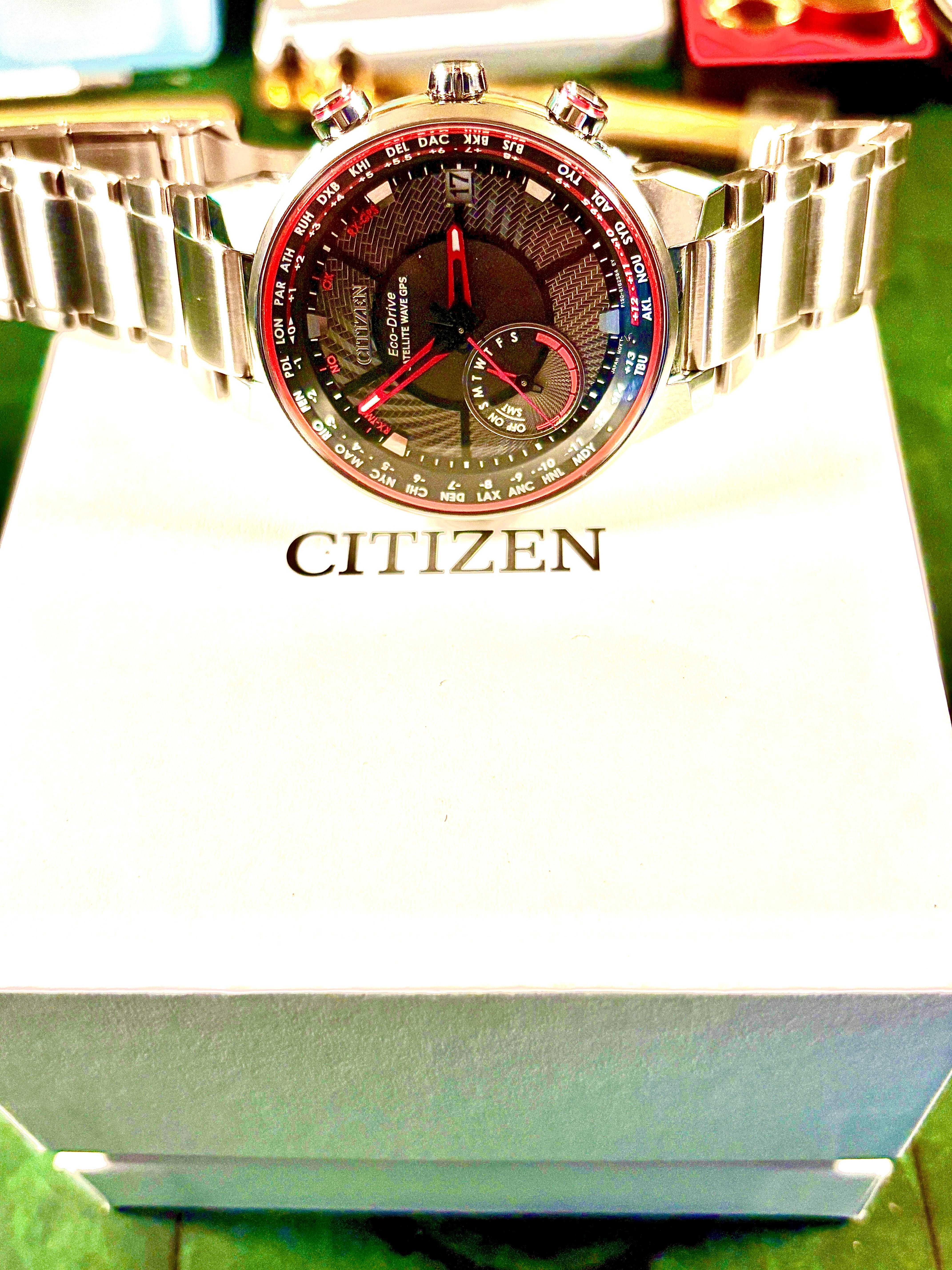
I did not buy this watch to collect it.
That sentence deserves to sit on its own for a moment, because it describes something that almost never happens in this collection. Everything in the case has a story that starts with want, with gap, with the particular pull an object has when it belongs in a life you are building. The Citizen Eco-Drive CC3031-51E Satellite Wave GPS started somewhere different. It started with a problem.
The Norwegian Prima leaves Port Canaveral on June 21st. Eight days, four ports, Nassau to Jamaica to Great Stirrup Cay to Cozumel and home. Every one of those stops runs on a different relationship with time — port arrival windows, excursion departure times, dinner reservations that do not move. I will be crossing time zones, stepping off a ship into equatorial heat at seven in the morning, and making my way back before the gangway lifts. A watch that requires a manual crown adjustment to update its timezone is a watch I will set wrong, or forget to set at all, or set correctly once and then get wrong again without noticing. That is not a small problem on a cruise.
So I did what the collection asks: I identified the gap, then found the piece that fills it exactly.
The CC3031-51E runs on the Citizen Caliber F950. It is an Eco-Drive movement, which means it draws power from any light source — indoors, outdoors, natural, artificial — and converts it through a photovoltaic cell beneath the dial. Citizen has been building Eco-Drive movements since 1976. This is not emerging technology. It is fifty-year-old engineering that has been refined to the point where a full charge runs the watch for approximately six months in complete darkness. I will not be in complete darkness. The charge question is settled before it becomes one.
Satellite Wave is the feature that resolved the timezone problem. The watch receives GPS signals from satellites orbiting at roughly 20,000 kilometers above the earth and uses those signals to set the time and timezone automatically, on demand, in a few seconds. I press a button. The watch finds a satellite. The time is correct. There is no crown to pull, no offset to calculate, no manual timezone database to scroll through. Nassau sets itself. Ocho Rios sets itself. Cozumel sets itself. I stop thinking about it.
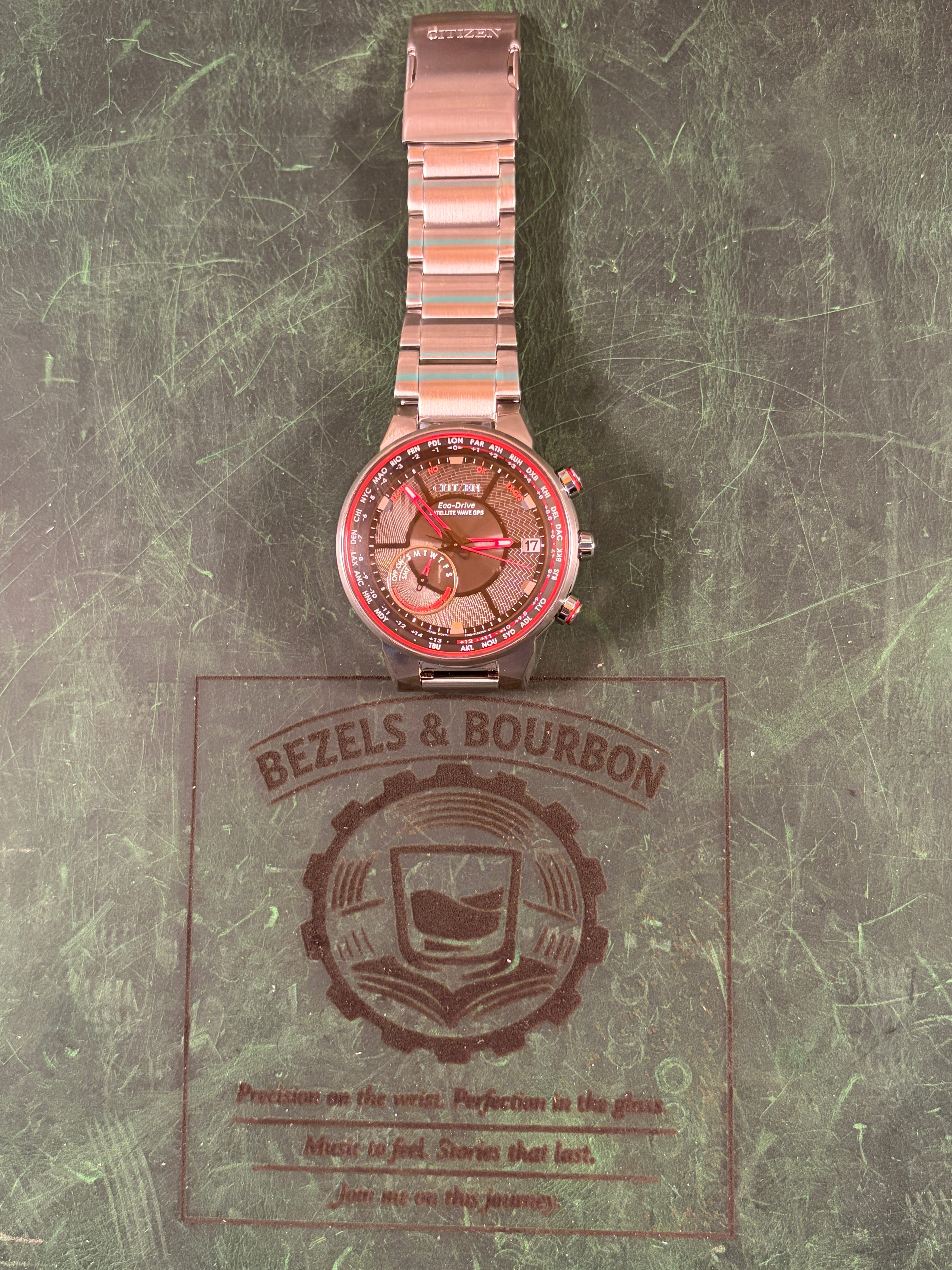
The rest of the spec: 44mm case in stainless steel, 100 meters of water resistance, mineral crystal over the dial, perpetual calendar that handles date corrections automatically forever. It is a substantial watch on the wrist and a precise one. It arrived from Best Buy for $407.67
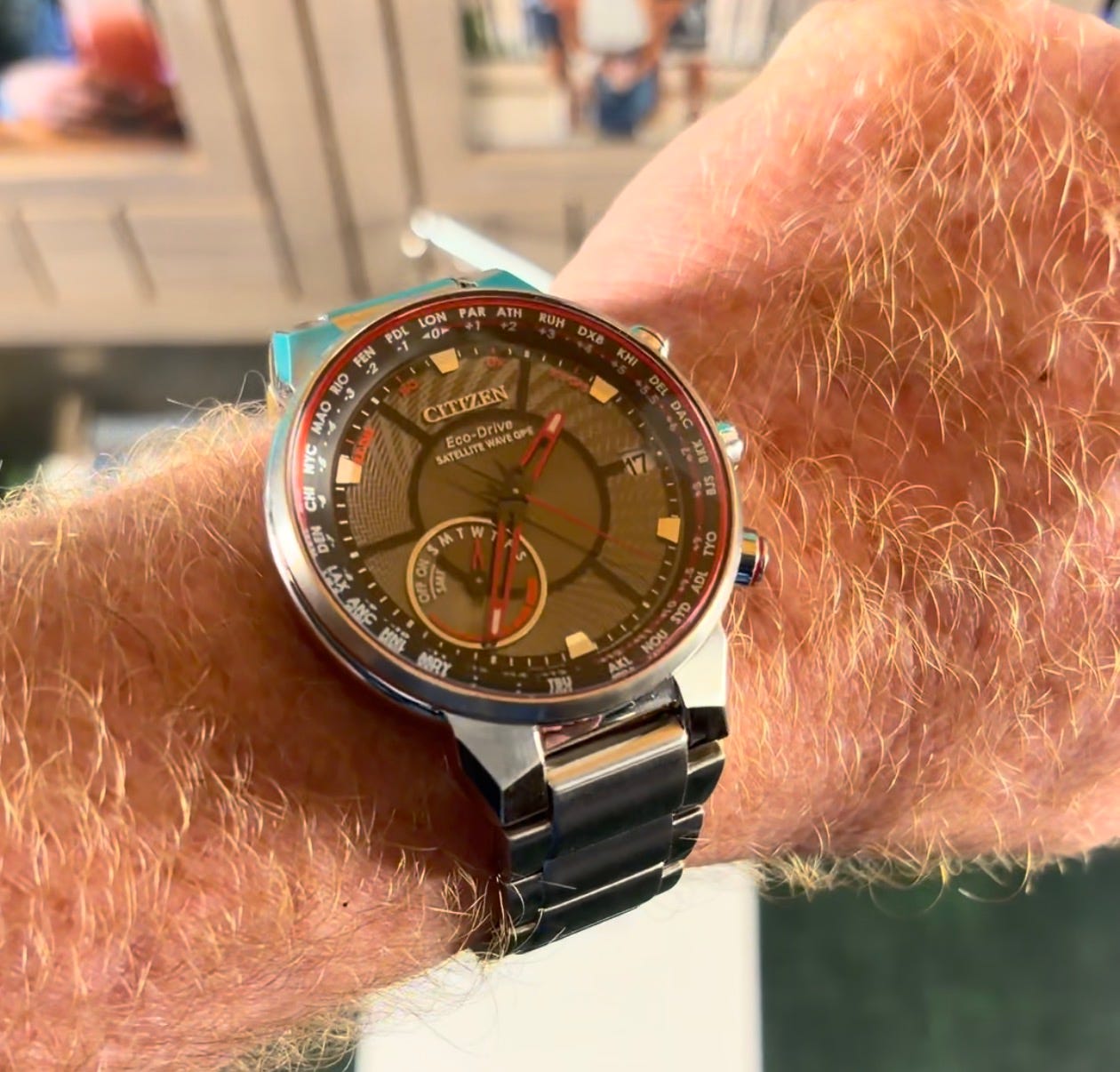
There is a version of this that runs further out. The Citizen F950 Attesa is the top of the Citizen Eco-Drive line: titanium case, in-house movement finishing, a watch that occupies a different tier of seriousness. I am not there yet with Citizen because I have not done the work with Citizen yet. This watch is the start of that work. If the CC3031-51E proves itself over years of travel, if the GPS function becomes something I rely on the way I rely on the Oceanevas in the water, then the Attesa becomes a legitimate roadmap consideration. The collection builds on evidence, not desire. The evidence starts accumulating June 21st.
I did not buy this watch to collect it. I bought it because it solved a problem. The collection gets to find out whether that is enough.
It usually is.
— Jaime
Precision on the wrist. Perfection in the glass. Music to feel. Stories that last.
bezelsandbourbon.com