
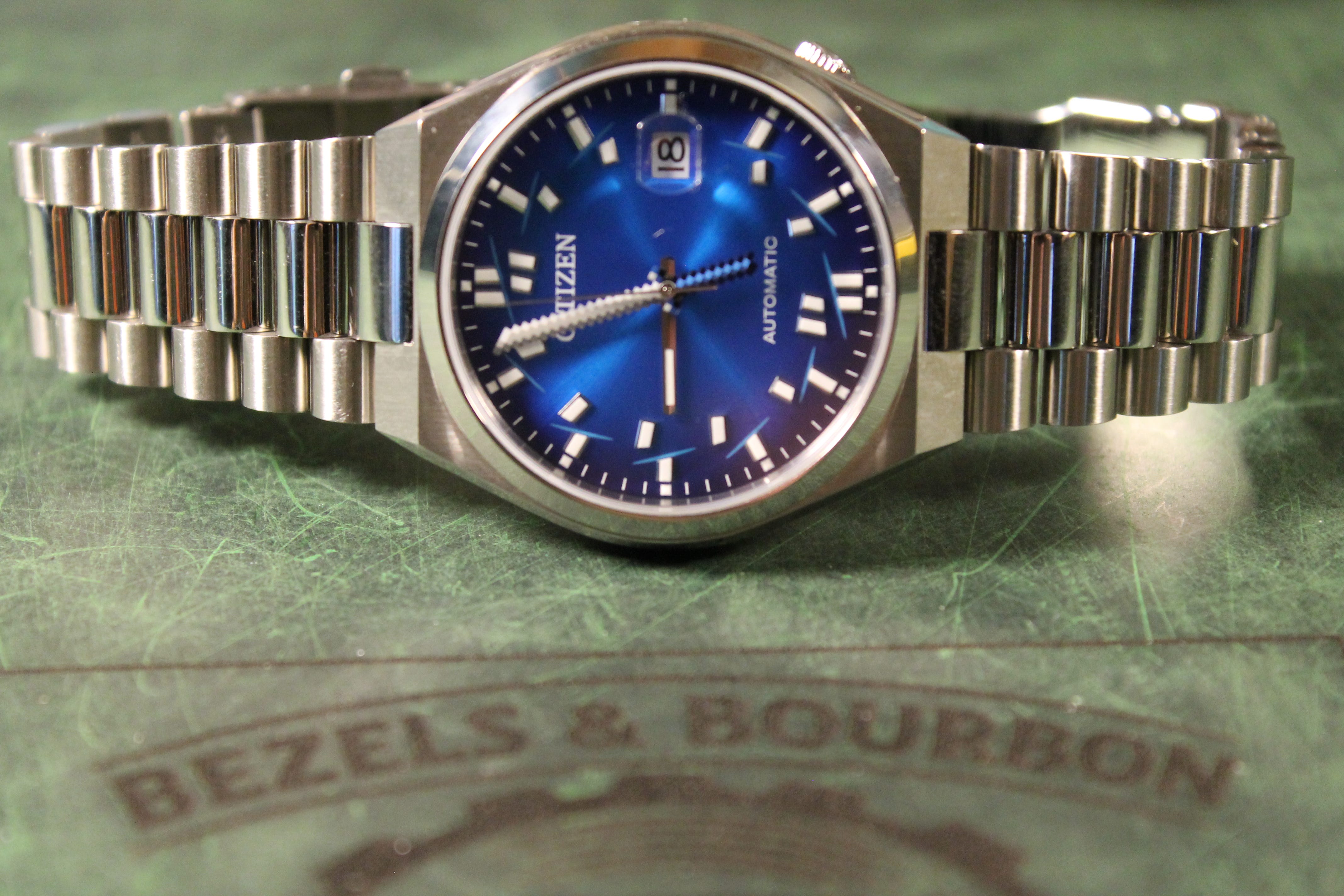
On February 25, 2026 this Substack was four days old. I hadn’t developed the framework, the rubric, or the philosophy for what belongs in a collection and what doesn’t. What I had was a release day and a dial that made me stop.
I bought the Citizen TSUYOSA x seconde/seconde collaboration on the day it dropped. I was very early in my watch collection and I didn’t understand that “limited edition” didn’t have the same weight in watches as it does in other items. This was limited to 3,600 pieces, it was a collaboration with a name that was recognizable in certain circles, and I thought it would appreciate in value. I thought people who knew watches would recognize it on my wrist. I was four days into writing about collecting, and I didn’t yet know the difference between following the market and trusting an instinct.
Romaric André had been doing this for years. The seconde/seconde collaborations weren’t new. The artist had a body of work across multiple brands before the TSUYOSA collab existed. I thought I was getting in on something at the beginning. I was actually walking into the middle of something already well established. I just hadn’t found it yet. Six months later, I understand what I actually bought.
The Man Behind the Hand
Romaric André is a 41-year-old Parisian who studied business, spent time in financial auditing, and in the mid-2000s found himself part of a venture that put a tourbillon mechanism inside a mobile phone. The project had serious backing — Edouard Meylan of H. Moser & Cie and Richard Mille himself were on the board. When the smartphone boom arrived, the company went bankrupt. The market had no room for a luxury phone with a watch complication inside it.
He could have gone back to auditing. Instead, starting in 2019, he began buying vintage watches. Rolexes, Omegas, and others, pieces he could find for a few thousand euros, and started asking what would happen if he swapped the seconds hand for something unexpected. A Millennium Falcon. A bee. An 8-bit sword. He called the project seconde/seconde, after the part of the watch that interested him most. The only thing on the dial in constant motion. The name itself translates from French as “second/second”, playing on both the unit of time (the seconds hand) and a secondary or altered perspective.
His first customer was William Massena, founder of Massena LAB and one of the most respected collectors in the watch world. That’s the level the work was operating at before most people heard of it.
By the time brands started coming to him, he had developed a clear philosophy. He never works against the original product. Whatever he removes, he stores, so the watch can always be restored to stock configuration. He’s playing with the DNA of a piece, not breaking it. H. Moser & Cie collaborated with him. Louis Erard. Zenith. Bamford. Nivada. Christopher Ward. Nine collaborations in, Time+Tide called him the watch world’s answer to Banksy. His response: he’s married, he has two kids — ‘can you be a rebel like that? That’s a sweet and smiley rebellion.’ He doesn’t call himself an artist. Creative is the word he uses. When asked what his favorite work is, the answer is always the same: the next one.
The Watch
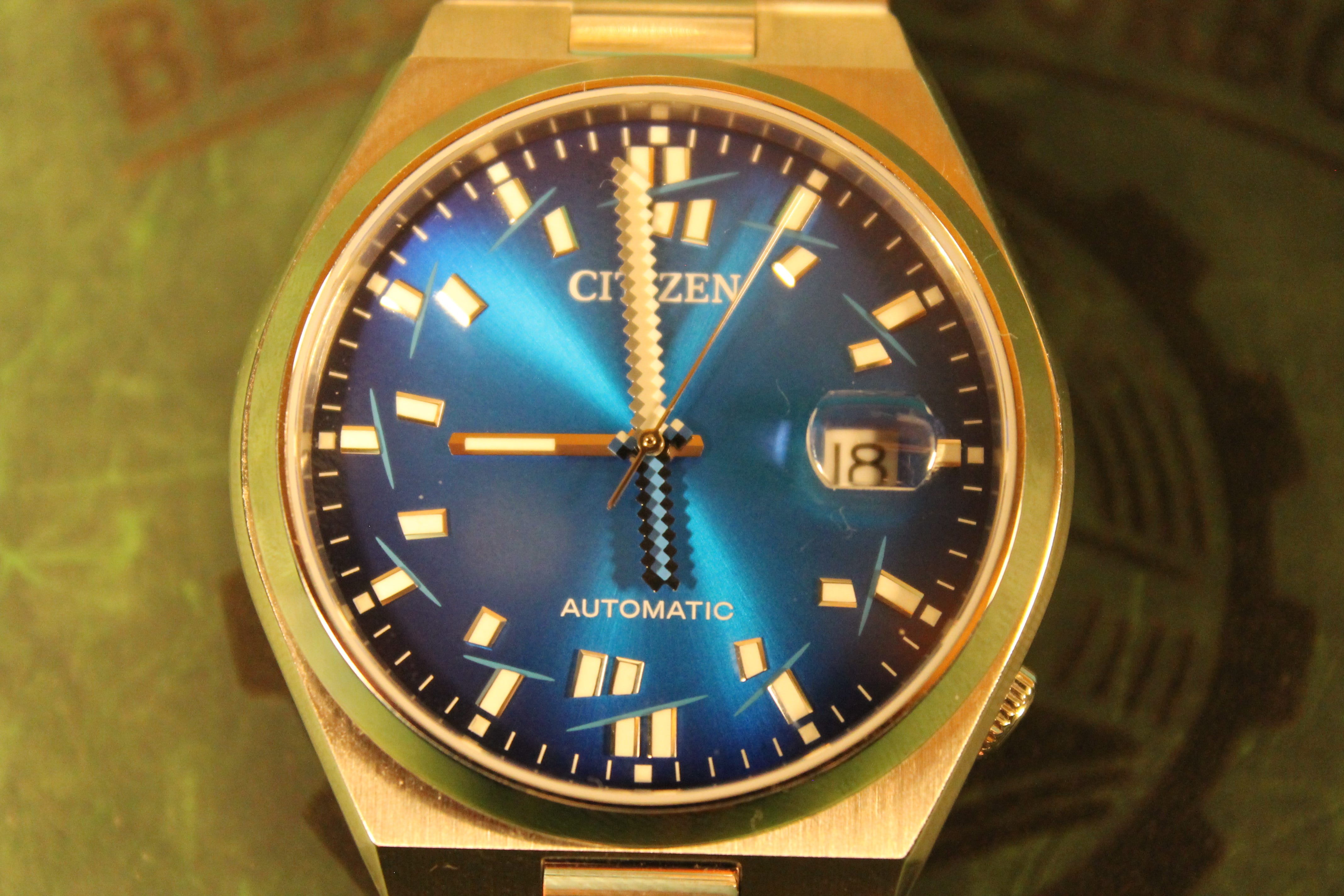
The TSUYOSA is a well-regarded Japanese automatic. 40mm, Citizen Caliber 8210, sapphire crystal, integrated President-style bracelet, 50 meters of water resistance. It wears closer to a Tissot PRX on the wrist than anything with significant presence, which is not a criticism. Citizen builds them honestly and prices them the same way. The base model without André’s hand would still be a capable daily automatic worth owning.
What André did to it is the point. Tsuyosa is Japanese for strength. He went looking for a symbol of traditional Japanese strength and landed on the katana, then built an entire logic around it rather than simply placing a sword on the dial. The minute hand is a pixelated katana, rendered in 8-bit video game language, scaled to the dial and set in permanent motion. The indices aren’t clean batons waiting for the sword to pass. They appear already sliced, offset, scattered across the deep blue sunray field as if the damage has been accumulating for a long time.
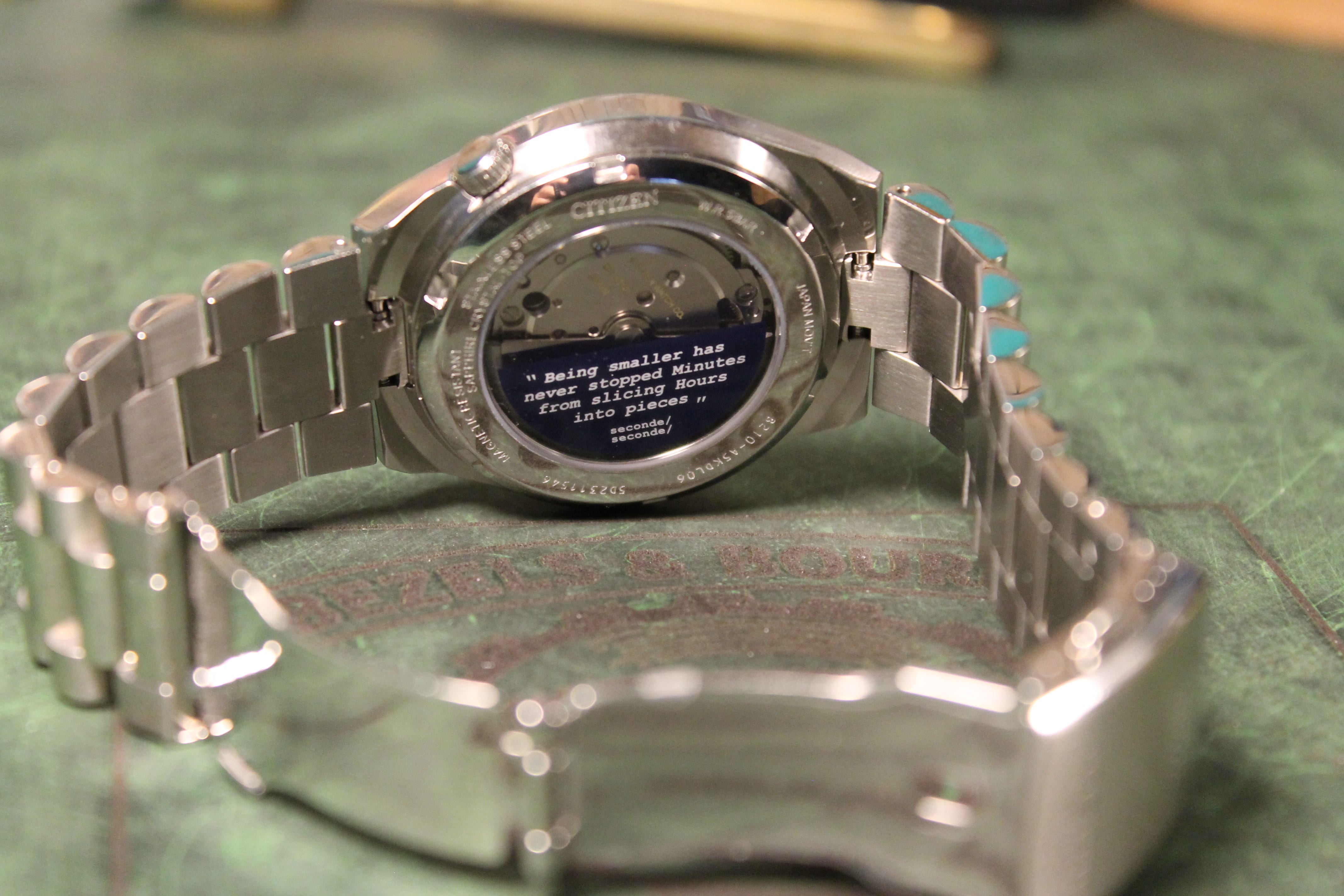
On the caseback: “Being smaller has never stopped Minutes from slicing Hours into pieces.” The clasp carries subtle sword-slash engravings across the brand logos. A motif that continues throughout all aspects of the watch, fully inclusive. He plays with the DNA and doesn’t break it. The TSUYOSA is proof of what that discipline looks like when it works.
Limited to 3,600 pieces. The number isn’t arbitrary — 3,600 is the number of seconds in an hour. André doesn’t miss details. Everything connects.
What the Hype Got Right
The first time I wore this watch in public was the day I went to pick up my Moonswatch. The sales associate noticed it and another customer said something too. That’s not a common experience with a $495 Citizen. I had bought it to produce exactly that moment.
The secondary market confirmed the rest. BNIB sets now move consistently between $800 and $950, with some listings touching $1,400. That’s a 65 to 90 percent premium on a watch that retailed for $495 and sold out at authorized dealers without coming back. The hype was right. Following it, in this case, paid off.
What Six Months Teaches You
The lesson of following the hype isn’t generally how you are supposed to build a collection. Many collectors see this as a watch industry trap. Most of the time the market is telling you what it wants you to want, and those are different things. But in this case, following the hype led me to an artist I didn’t know existed, who had been doing serious, considered, clever work for years before I found him.
Since February I’ve acquired six more seconde/seconde pieces across four other brands. I knew I was creating a collection within the collection after the second watch. Each one since has arrived because of the same collector’s philosophy I described in “All In”. Find the niche and run with it.
The other thing six months teaches you is self-knowledge. I’m not the kind of guy who wears fun watches, at least not often. That’s not a complaint about the watches. It’s an honest accounting of who I am as a collector. The TSUYOSA is fun and beautiful, probably the best seconde/seconde collaboration to date, and it doesn’t earn significant wrist time. What it earns is its place in a sub-collection built around an artist’s body of work. That’s a different kind of value, and it took owning several of these pieces to understand it. I treat these more like pieces of art than watches.
The sub-collection has its own logic now. Most of these watches exist because of what André did to the dial, not because of what the watch does on the wrist. I’m considering giving them their own dedicated storage, a separate winder and box for the seconde/seconde pieces alone. Museum pieces deserve a proper room.
In the end, if I knew then what I know now, would I buy this watch again? Yes, but for different reasons. Not because of the secondary market. Not because it launched a series. Because the watch is genuinely good, the artist is genuinely serious, and clever has a permanent place in this collection regardless of where it sits in the rotation. It isn’t high horology. It doesn’t belong at a Michelin-starred table. It’s casual by nature and honest about it, which is its own kind of integrity.
I bought it for the wrong reasons at the time. But time revealed the instinct underneath those reasons that turned out to be right. That’s probably the most useful thing collecting has taught me so far, as the hype fades, what you actually responded to shines through.
The Numbers
The TSUYOSA x seconde/seconde/ scores 58 out of 100 on the B&B rubric. The 3,600-piece numbered limitation and André's fully executed sword concept push it up. The standard Citizen case, commodity movement architecture, and the honest fact that this was a pre-framework impulse purchase hold it down. SPR is Over — $529.65 paid in taxes and shipping on a $495 MSRP puts it just above retail, but the score relative to its tier makes the acquisition defensible. FMV at 58 points works out to $490, meaning I paid $39.65 above fair value on release day. The secondary market has since moved to $800–$950 for BNIB sets. Both the original price and the FMV are well below what it costs to acquire this watch today.
— Jaime
Precision on the wrist. Perfection in the glass. Music to feel. Stories that last.
bezelsandbourbon.com