
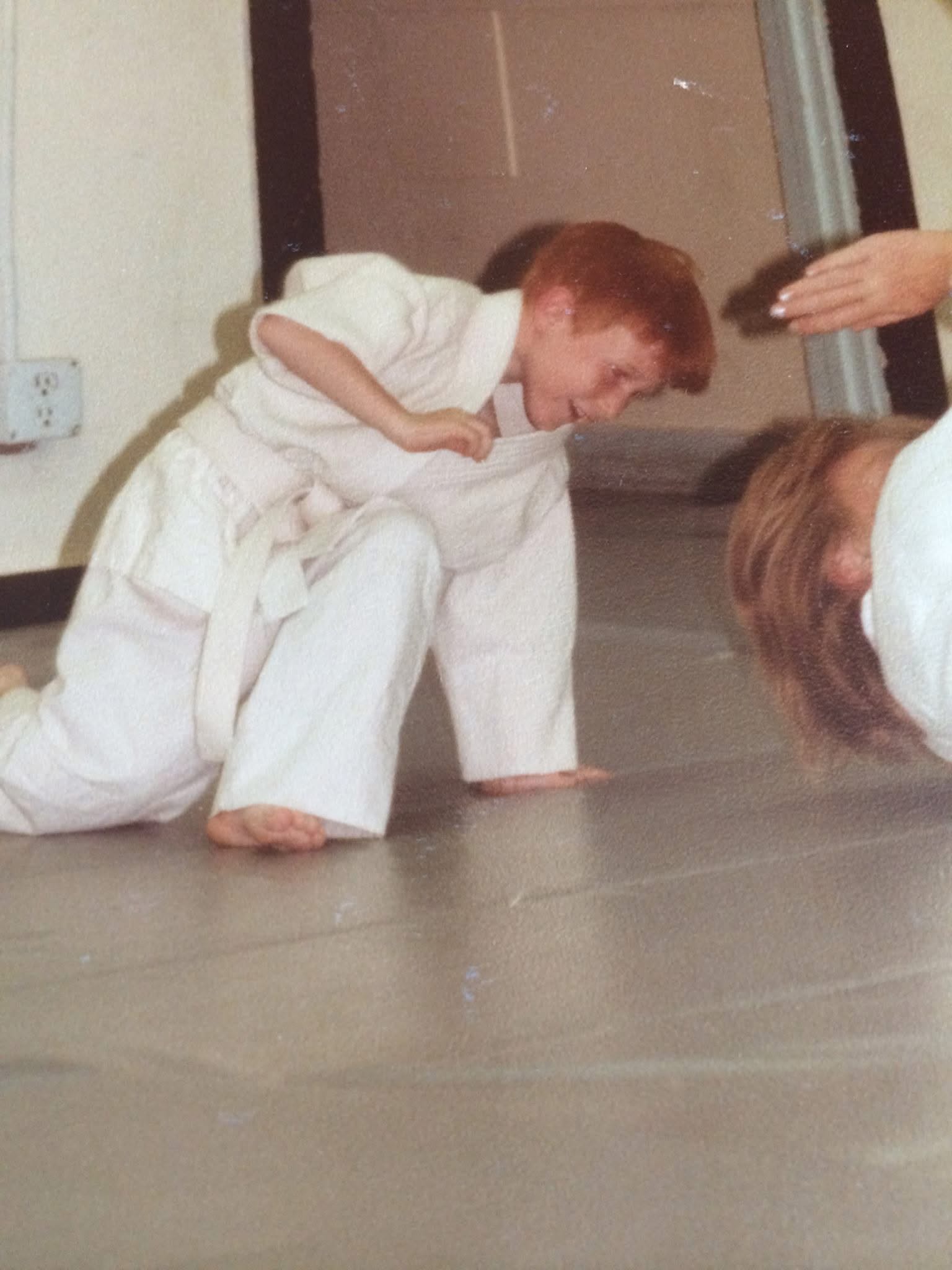
It started with judo.
1986. El Paso, Texas. My father was a Drill Instructor at Fort Bliss, which tells you everything you need to know about the household I was growing up in and nothing at all about what to do with a second-grader who had more energy than any reasonable adult knew how to manage. My parents found a local judo school. I earned a yellow belt. Then we moved to Virginia, and that was that.
Except it wasn’t.
The seed doesn’t care whether the conditions are right. It just waits.
—
Thirty years of motion followed. Soccer. Baseball. Basketball. Football. Track — senior captain, MVP, the kind of kid who needed something to run toward. Then adult life, which has its own momentum and its own way of burying things that aren’t urgent. Body Combat at a gym, eventually certified to teach it, because if I was going to do something I was going to understand it from the inside. And then, somewhere in my mid-thirties, the decision to become a better instructor led me to the closest dojang to my office.
I was a white belt. I knew nothing about ATA — the American Taekwondo Association — and less than nothing about the two people whose names were on the door.
That was twelve years ago. I’m still there.
—
Chief Master David and Chief Master Laura Kowkabany are 8th-degree black belts in an organization where 9th degree is Grand Master and the 10th — held by founder HU Lee, who has been gone for years — will never be awarded again. Both of them have been offered the 9th degree path. Both of them declined.
They have one school. In Tampa. Every class taught by their own hands — not delegated to a 4th or 5th degree while they oversee a franchise from a distance. In an organization where most 8th and 9th degrees run empires, the Chiefs run a dojang. They chose the mat over the institution, every time, for forty years. There is no other school in ATA directly taught by an 8th degree. There are two of them here.
I didn’t know any of that when I walked in as a white belt at thirty-six.
I just knew I wanted to learn.
—
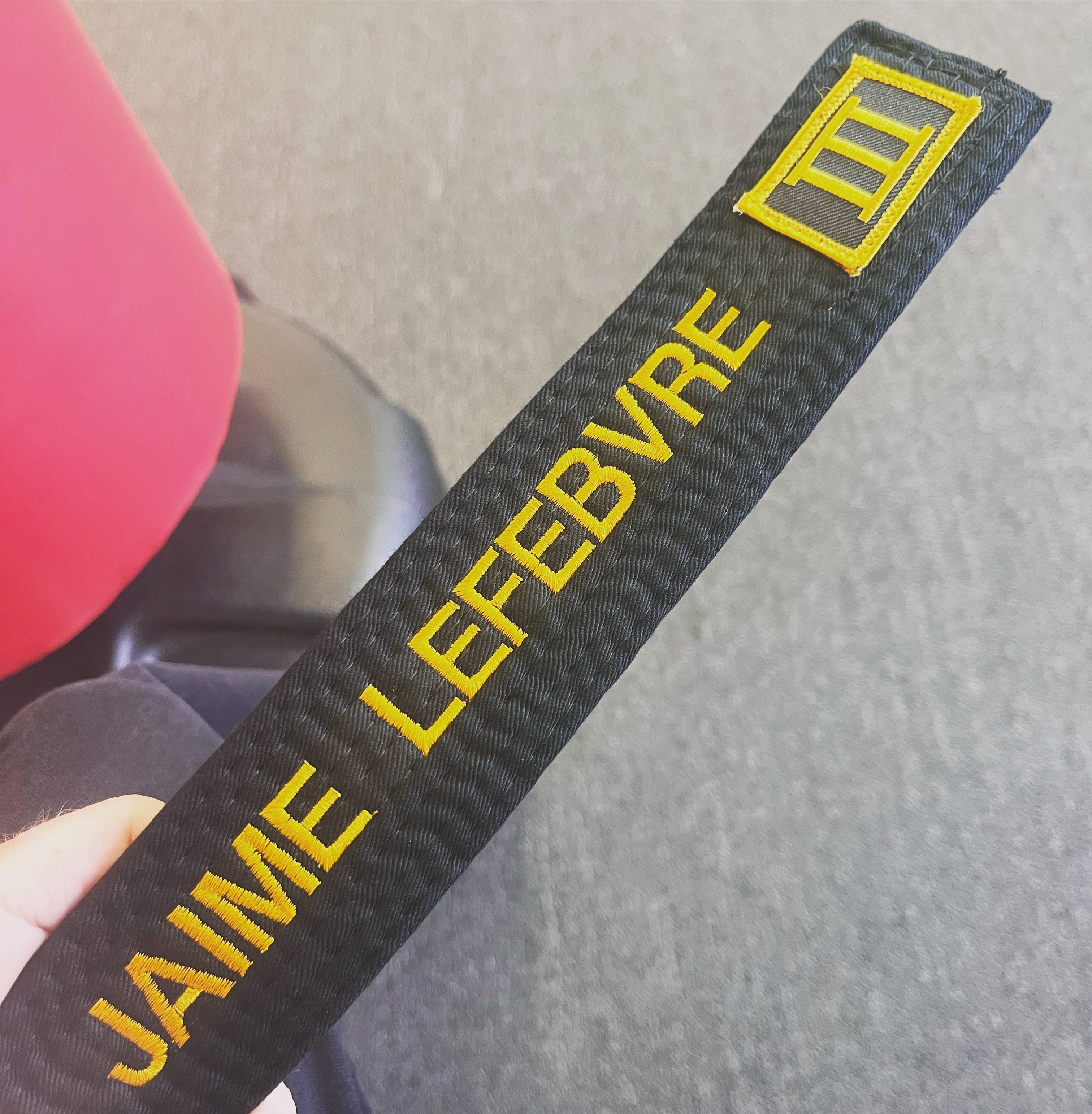
Chief LK told me once that I move like a martial artist.
I have received awards. I have been recognized for things built and restored and competed for. I have had people say kind things about work I’ve done across twenty-four years in construction, across a career that has left physical marks on this city.
Nothing has landed the way those six words did.
Coming from someone who was once the highest-ranked woman in the ATA — who has spent four decades giving herself to this discipline, who chose one school and one community over everything the organization would have handed her — those six words were not a compliment. They were a verdict. Delivered quietly, the way she delivers everything, because the Chiefs have never needed volume to make a point land.
—
By 2018 I had earned my brown belt and entered my first tournament. Tallahassee. One day of competition against people who knew what they were doing in ways I was still learning to understand.
I was not good.
I want to be precise about that, because the instinct is to soften it — to say I held my own, or that it was a learning experience, or that the point was just to compete. All of that is true and none of it is the truth. The truth is I went to Tallahassee and I got a clear and unambiguous picture of exactly how much I didn’t yet know. I drove home with that picture and I studied it the whole way back.
That’s what losing is for, if you let it be.
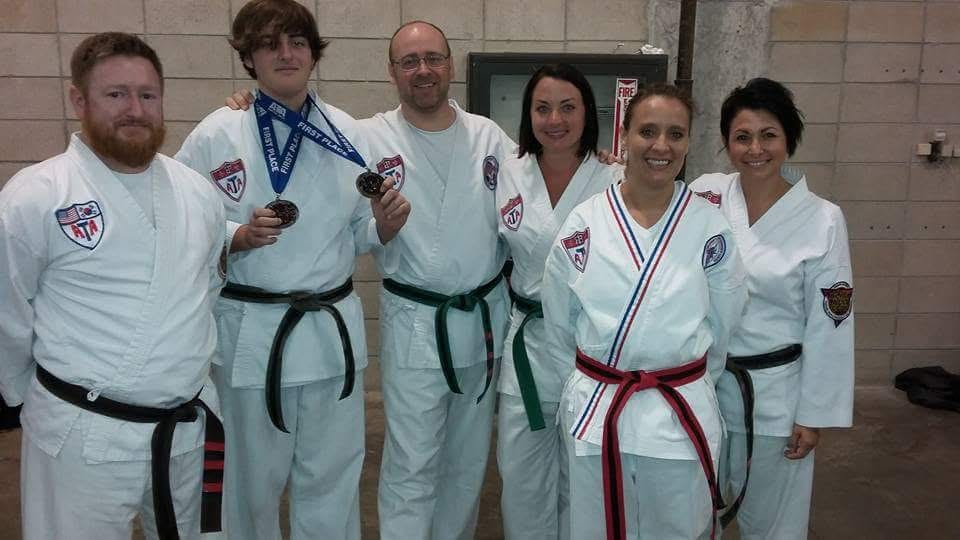
2019. First-degree black belt. State champion in sparring, forms, and combat weapons — all three disciplines, same year.
I’m not going to dress that up. It happened because of one bad day in Tallahassee and everything I did with it between then and the moment I stepped back onto a tournament floor. The loss was the lesson. The championship was the proof that I’d actually learned it.
—
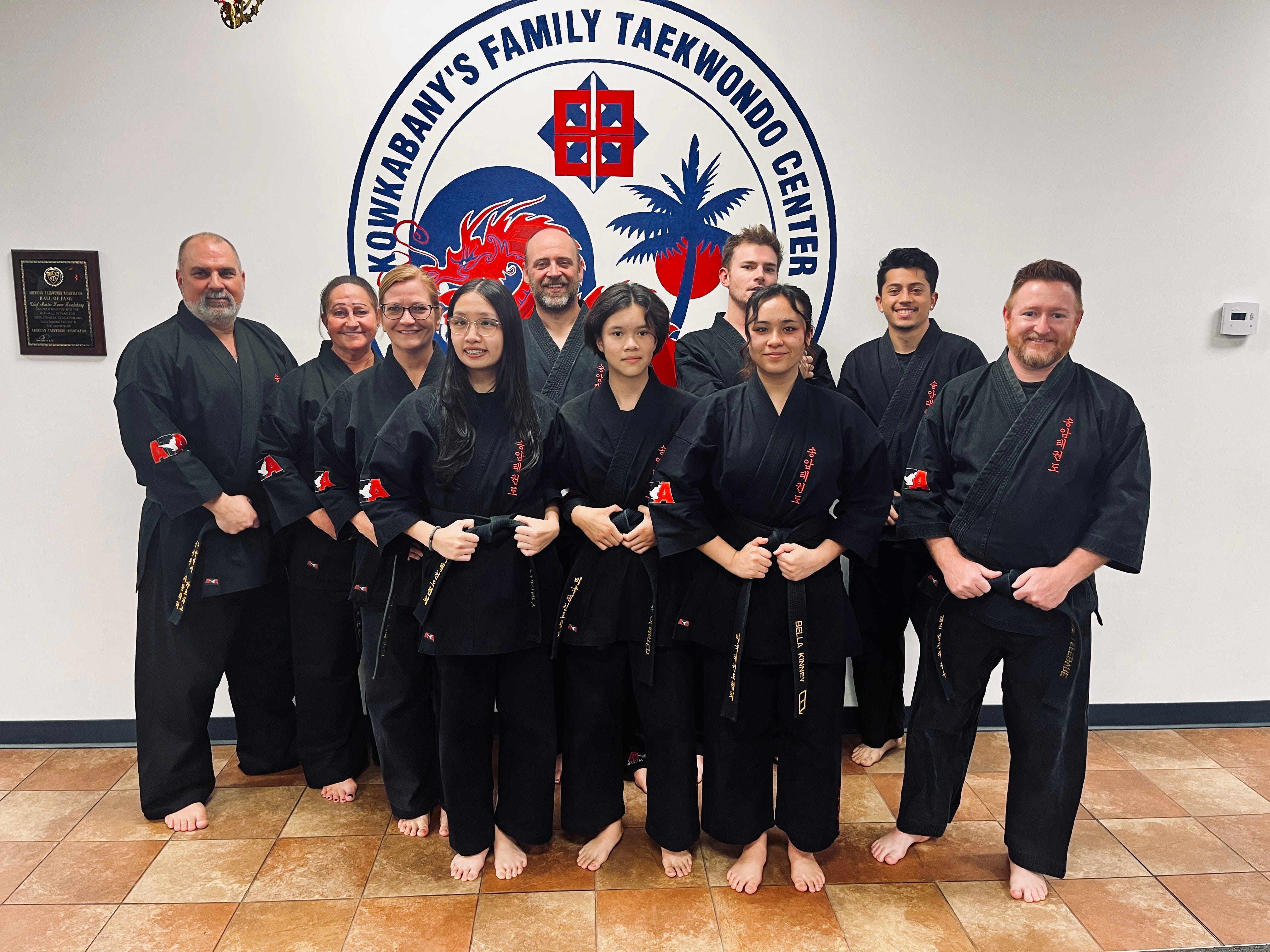
Twelve years in, I am the senior student at KFMA. Highest rank outside the Chiefs themselves. More than a full year ahead of the next person in the school.
What that actually looks like is five days a week. I take the 4:30 family class — mostly color belts, younger students. It’s a good warm-up for me and something else entirely for them: the chance to train alongside someone who has been doing this for twelve years. I provide instruction in forms and sparring combinations. Then we mix it up. Full contact, full protective padding. I go very lightly. That’s not generosity — that’s the only responsible option. But I’ve come to understand that going lightly against someone much more advanced is its own kind of education. They feel what good movement looks like before they can fully replicate it.
Monday and Wednesday at 5:15 is Master Club — the most advanced class in the school, the black belts, the ones who have stayed long enough to know what they don’t yet know. It is energetic. That’s the polite version.
Then the 6:30 class, daily, where I stand beside Chief DK and give instruction. I don’t participate in sparring or drills directly at that hour. I teach.
I also sit on the testing panel for lower ranks. I make notes. I give scores. I am notoriously a low scorer — not out of harshness, but because I’m out there on the mat every day. I know what the standard looks like from the inside. I know these students in ways the Chiefs sometimes don’t, because I’m the one going lightly with them at 4:30 while they figure out how to move. My expectations come from proximity, not distance. I think that’s the right place for them to come from.
—
Chief DK said something to me not long ago that I’ve turned over in my mind more than once since.
He said I was like a brother to him. That he considered the three of us — the two Chiefs, the senior student — closer than family.
From a man who turned down Grand Master. Who has one school and forty years on the mat and no interest in anything the organization would have handed him beyond the work itself. That’s not a thing you say casually. That’s a thing you say when you mean it.
I’m working toward my fourth degree. Seven midterm testings completed, one left later this month, final testing in December. In ATA, rank accumulates slowly by design — fourth degree requires four years in rank, third required three, and so on. The time is the point. You can’t shortcut what you haven’t yet lived. After that, the Legacy program, certification, the path to becoming an instructor in the way the Chiefs are instructors — not just someone who teaches, but someone qualified to certify others.
That’s where this is going. That’s what twelve years on the mat looks like when it compounds.
—
Every year, around Christmas, I gather what I can from the students and parents. A little over two thousand dollars, usually. I choose the gifts for the school — new vegan leather chairs for the parent section two years ago, a real upgrade — and I choose the personal gifts for the Chiefs.
For Chief David: bourbon. Military history. Philosophy. A man who has spent forty years studying how human beings move and think and break and endure has predictable taste in what he reads, and it’s not predictable in a small way.
For Chief Laura: candles, soap, and books — feminine leadership, spiritual texts, the kind of reading that builds something inward as steadily as the mat builds something outward. The candles and soap carry their own tradition — a gift that gives itself away in the using. Every time you light the candle, you lose a little of it. Every time you use the soap, it diminishes. To give someone a candle is to give them something that asks to be consumed in the act of being received. Forty years of martial arts. Forty years of giving herself away in exactly that way, class after class, student after student, one school, no empire.
The gift matches the person. That’s the only standard worth applying.
I’ve been choosing these gifts for years now. Since the previous senior student left and that responsibility found me, the way most of the right responsibilities eventually do — not assigned, just inherited by the person who was already paying attention.
—
The Chiefs are forty-plus year martial artists. Both of them are proficient in numerous weapons. We train knife defense drills at KFMA. Knives go with who they are — not as accessories, but as extensions of a discipline that has always understood the blade as a subject worth studying seriously.
In 2024, at Christmas, they gave me a Gerber Ultimate Fixed Blade. Four point eight inches of high carbon stainless, textured rubber grip, and a sheath built to keep you alive — fire starter, whistle, diamond sharpener, everything you need to not be finished by whatever the moment throws at you.
In 2025, they gave me a SOG Sogfari Kukri. Twelve inches of blade. Eighteen inches overall. A sawback spine, a spiked tang for pounding, a knife built not for surviving in place but for moving through — clearing the path, making passage where there wasn’t one before.
Both years. Both Chiefs. Jointly, privately — the two of them and the three third-degrees, no audience beyond the people who had earned the right to be in the room.
I don’t know if they planned the progression. I’ve never asked. But the story those two knives tell in sequence is not a subtle one. Year one: here is what you need to survive. Year two: here is what you need to advance.
That’s not a gift strategy. That’s a philosophy. And it comes from two people who have been teaching philosophy on a mat in Tampa for forty years, whether they call it that or not.
—
I didn’t set out to collect knives. I don’t think I would have arrived at it on my own, at least not yet.
But I know what happens when something enters my life with real provenance behind it. It happened with watches — one Bulova at twenty-seven, and then years later a door I couldn’t stop walking through. It happened with bourbon, with records, with shoes. The collecting instinct doesn’t announce itself. It waits for an object that carries enough weight to wake it up.
The Gerber woke it up. The SOG confirmed it.
They’re on the green felt mat in my study now — next to the loupe and the strap tools and the bourbon glass in the corner of the frame. Objects that came from two people who spent forty years becoming exactly who they are, given to a student who spent twelve years paying attention.
A new collection starts where the last one did: with a gift that meant something, from someone who knew what they were handing over.
I didn’t walk into that dojang in 2014 knowing any of this was coming.
The seed doesn’t tell you what it’s going to grow into. It just waits for you to show up and stay.
—
Precision on the wrist. Perfection in the glass. Music to feel. Stories that last.
bezelsandbourbon.com