
A stranger on TikTok typed a brand name and kept scrolling. That was it. No recommendation, no review, no context. Just a name dropped in a comment on someone else’s video — Escudo — and then gone. I followed the thread to their page, found a post showing the Silver Rose, and left one comment.
Is this still available?
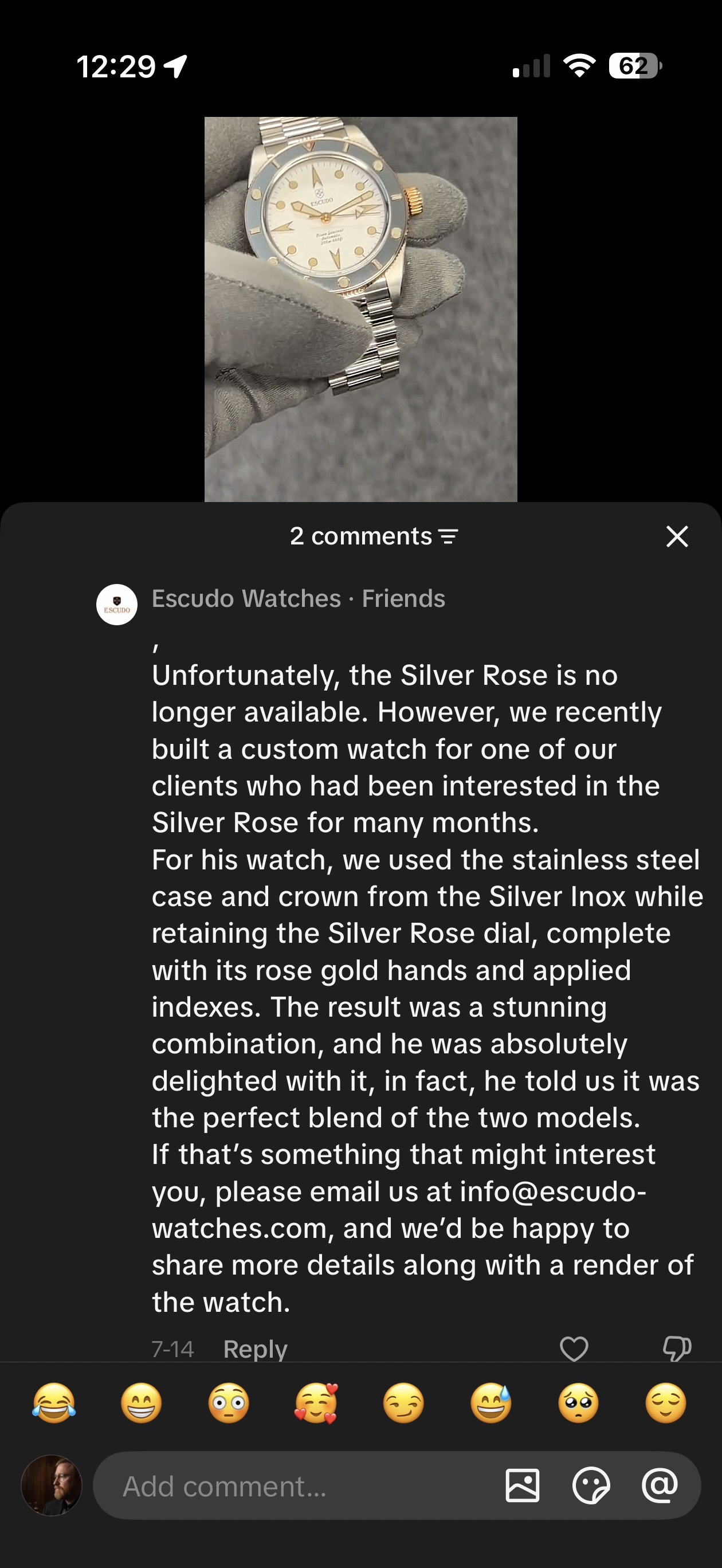
Unfortunately, the Silver Rose was discontinued. But they offered to build me something close — a custom watch using the Silver Inox case with the Silver Rose dial, a bronze crown substituting for the rose gold coin-edge they could no longer produce because they’d sold out of the bronze cases the original required. I looked at the renders. They were genuinely beautiful but not the same.
What came out of the five days of email that followed was something better than what I originally asked for. One of the last ex-demonstration Silver Roses they had — the watch that had traveled to events, that had sat in a display case and let strangers admire it and put it back. Professionally valeted. Brand new bracelet. Full four-year warranty. Offered to me because I asked the right question at the right time. I had to say yes.
The name Escudo comes from two places. The shield on the Portuguese coat of arms. And the Portuguese currency before the Euro. Founded in 2020 by Simon Correia and Richard Johnson — two watch collectors who wanted to build something worthy of that name — their first watches reached the market in 2022. The Silver Rose launched in 2023. Two years later, it was gone.
The brand draws its identity from the early Portuguese and British explorers who mapped the world with nothing but primitive navigation tools, mathematics, and instinct. The Ocean Seacrest wears that heritage quietly. Arrow-form hour markers at the cardinal points — compass geometry translated into a dial layout, nautical without being loud about it.
The heart of the watch is Swiss — a Sellita SW200-1 base — assembled in Winchester, England. Escudo modifies and regulates it to the Calibre 1488. A borrowed heart, honestly claimed, in a case built to honor the navigators who trusted their lives to precision.
The outer box arrived wrapped in a map of the Atlantic. Silk ribbon. A wax seal in deep red — the kind you break slowly because breaking it is the point. Inside, a smaller box. Inside that, a printed card. Simon and Richard welcoming every Escudo buyer to the family, asking them to share their observations. A consideration from a small brand that thought carefully about the moment of opening. That’s worth something.
Turning the watch over reveals a two-piece caseback. The outer ring rotates independently so the engraving always sits perfectly aligned — north-south, every time, regardless of how the watch sits on the wrist. Nobody needed to engineer that. It solves a problem most collectors never consciously register. Escudo did it anyway. That’s what attention to detail actually looks like — not announced, just present, waiting for whoever notices.
There’s a category collectors call the desk diver. A watch rated for the deep end that never gets there. The Silver Rose is the most exquisite example of one I’ve ever held. Better suited for the yacht club than the depths below.
Thirty-nine millimeters. 316L stainless steel, 12.8mm thick. Two hundred meters of water resistance. Running at 28,800 vph with a 38-hour power reserve. Sapphire crystal with triple AR coating concealing a holographic logo that only reveals itself when you breathe on it — a hidden detail built into every watch they make.
The bezel is the thing. Mirror-polished stainless steel that shifts between silver, black, and white depending on the angle of light. Oracle Time’s reviewer said it was nearly impossible to photograph because the camera kept reflecting back at itself. I understand that now. The bezel is the kind of surface that makes you tilt your wrist in the middle of a conversation — not to check the time, just to watch the light move across it.
No rotating timing bezel. No massive coin-edge crown. No lume pips stacked around the chapter ring like depth charges. Rose gold hands and applied indexes, matte silver dial, a case that could slip under a dress shirt cuff without announcing itself. Escudo could have built the Silver Rose to wear its depth rating on its face. Instead they built a watch too exquisite for the depths it’s rated for.
I’ll never take this watch diving in the ocean. Not because it isn’t capable. Because it’s too beautiful.
Now the honest part. Over the last few months, I have developed a rubric to help me decide which watches are helping me to curate a collection rather than a collection of pieces. The rubric scores every watch on a 100-point scale across 20 questions covering brand architecture and individual watch merit. Each question is worth 1-5 points. I ran the rubric after the watch arrived. Fifty-eight out of a hundred. The brand block is where it falls — a post-2015 direct-to-consumer microbrand with no service network, no manufacture depth beyond a named Sellita, and a recent founding history. The Score-to-Price Ratio compares the rubric result against the price paid relative to tier expectations. A score of 58 at the Basic Luxury tier ($1,500–$3,000) produces an Unacceptable SPR — meaning the score doesn’t justify the price paid at that tier. The Score-to-Price Ratio came back Unacceptable. The rubric put fair value somewhere between $750 and $1,100. I paid $1,895 for the watch plus $90 for a Silver Rose-specific leather strap. Total: $1,985.
I would still make the same decision again. Sometimes a number in a spreadsheet can’t tell the whole story.
I want to be careful about how I say that, because there’s an easy version that turns this into a regret, and that’s not what it is. The watch is genuinely one of the most beautiful objects I own. The mirror bezel works in ways photographs can’t capture. The two-piece caseback is the kind of detail that makes you trust the people who built it. The provenance — one of the last ex-demos, closed window, five days of correspondence with the directors directly — is real and not reproducible.
But the rubric scored the brand on what it can prove, and what Escudo can prove in 2026 is limited. They’ve been building watches for four years. The Sellita base is honest and serviceable and completely correct for a brand at this stage. None of that changes the number. A 58 on the rubric, against an $1,895 price tag, produces the result it did. The framework caught what the story almost talked me past.
What the provenance argument actually holds is that this watch can no longer be bought from Escudo at any price. The window was open for five days in July 2026. The ex-demo was either going home with me or going back into storage until someone else asked the right question. The rubric doesn’t have a line item for that. Neither does the SPR. The premium I paid was partly for the object and partly for the closing door, and I went in knowing that even if I didn’t say it in those words.
All of these things are true at once, and I’d rather have it in writing than let the beautiful object quietly eat the honest number.
A stranger typed a name and kept scrolling. I followed it to here.
THE NUMBERS
The rubric scored the Escudo Ocean Seacrest Silver Rose 58 out of 100 — the brand block pulls the number down, a post-2015 DTC micro still proving itself with a Sellita base and no established service network. The Score-to-Price Ratio came back Unacceptable, meaning a 58 doesn’t justify the Basic Luxury tier ($1,500–$3,000) where the $1,895 price tag lands. FMV for a 58-scoring watch sits between $750 and $1,100. I paid $1,985 all in. The gap between what the framework says it’s worth and what it cost is real — and so is the watch on my wrist, the window that closed five days after I found it, and the reason none of that gap changes my answer.
— Jaime
Precision on the wrist. Perfection in the glass. Music to feel. Stories that last.
bezelsandbourbon.com