
I wrote a whole article about how to pack a watch box for a cruise. Five watches, seven nights, each one assigned a role I had reasoned my way into before the ship left port. It was good advice. I stand behind every word of the framework.
Then I went on the cruise.
Here is what the wrist time actually said, which turned out to be a different conversation than the one I planned.
The Five, Reconsidered
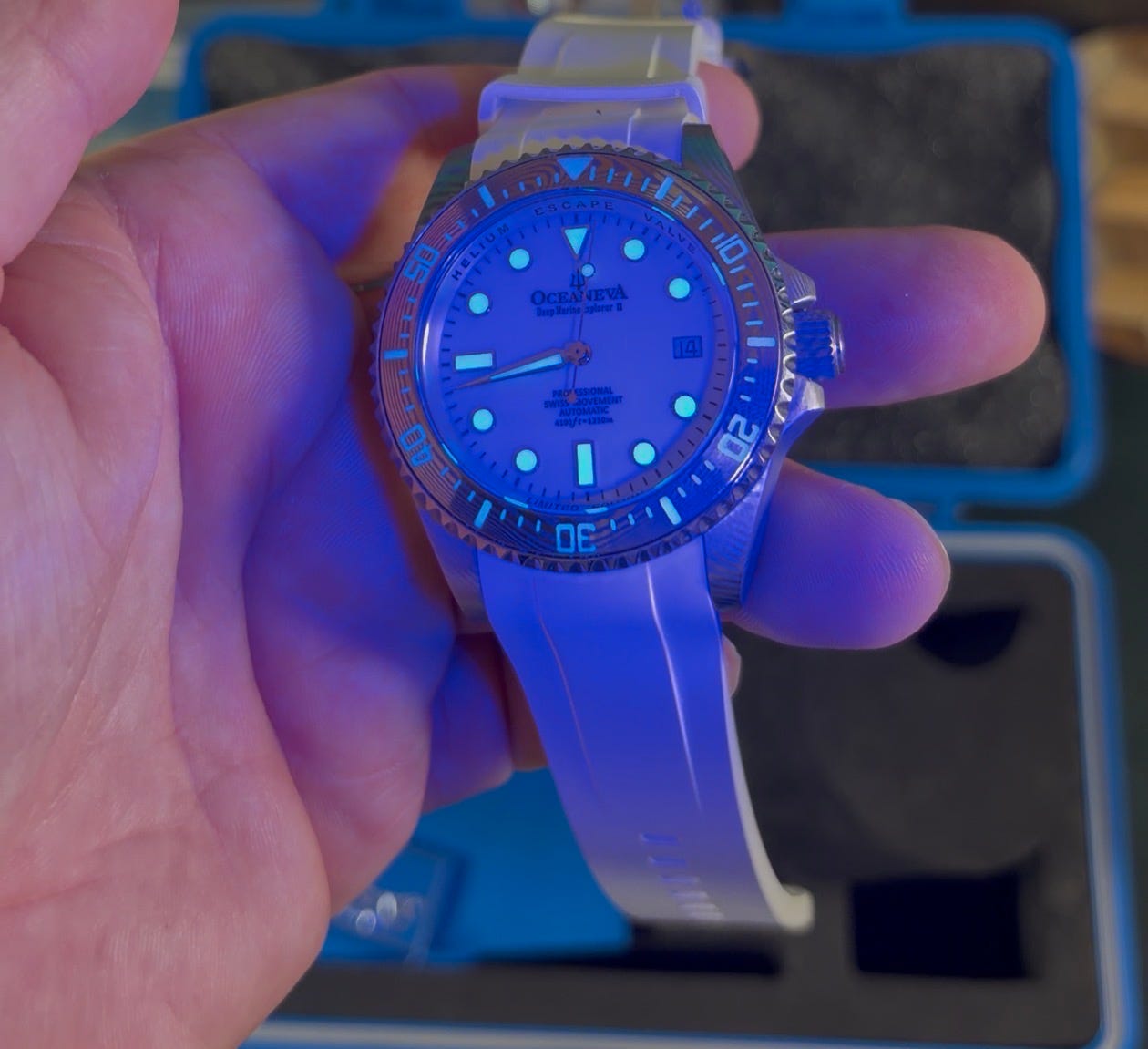
The Oceaneva Deep Marine Explorer II in Damascus and White did all the work.
I packed it as the party watch. The Glow Party was night seven, white was the move, and I had a watch with a white enamel dial and a white rubber strap waiting for exactly that moment. We never made it. I was on a hot streak in the casino and chose the table over the dance floor, which is a story for another article, and the themed night the watch was named for came and went without us.
It did not matter, because the watch had already justified the trip. It climbed Dunn’s River Falls. It sat poolside at the private island. It went into the ship’s hot tub and came to the weight room. It became the piece I reached for without thinking, every wet and active hour of the week. The FKM strap and the dive rating did exactly what they were built to do, and I had filed them under decoration for a party we skipped. The watch I packed for one night I never attended earned the entire week instead.
The Oceaneva Deep Marine Explorer II in Navy got one good compliment and a quiet retirement.
This was supposed to be the every day watch. What it actually got was a strong opening night and almost nothing after. One of the sales associates in the ship’s watch shop complimented it the first evening, which is the kind of endorsement that means something coming from a person who stares at watches for a living. Then I barely wore it again. The Damascus and White had taken over the role I assigned the Navy, and two dive watches in a five-watch bag is one dive watch too many. I did put the Navy back on for the last morning, breakfast and the long way home, which felt right. A watch that bookends a trip without filling its middle is still a watch that was there for the parts that mattered.
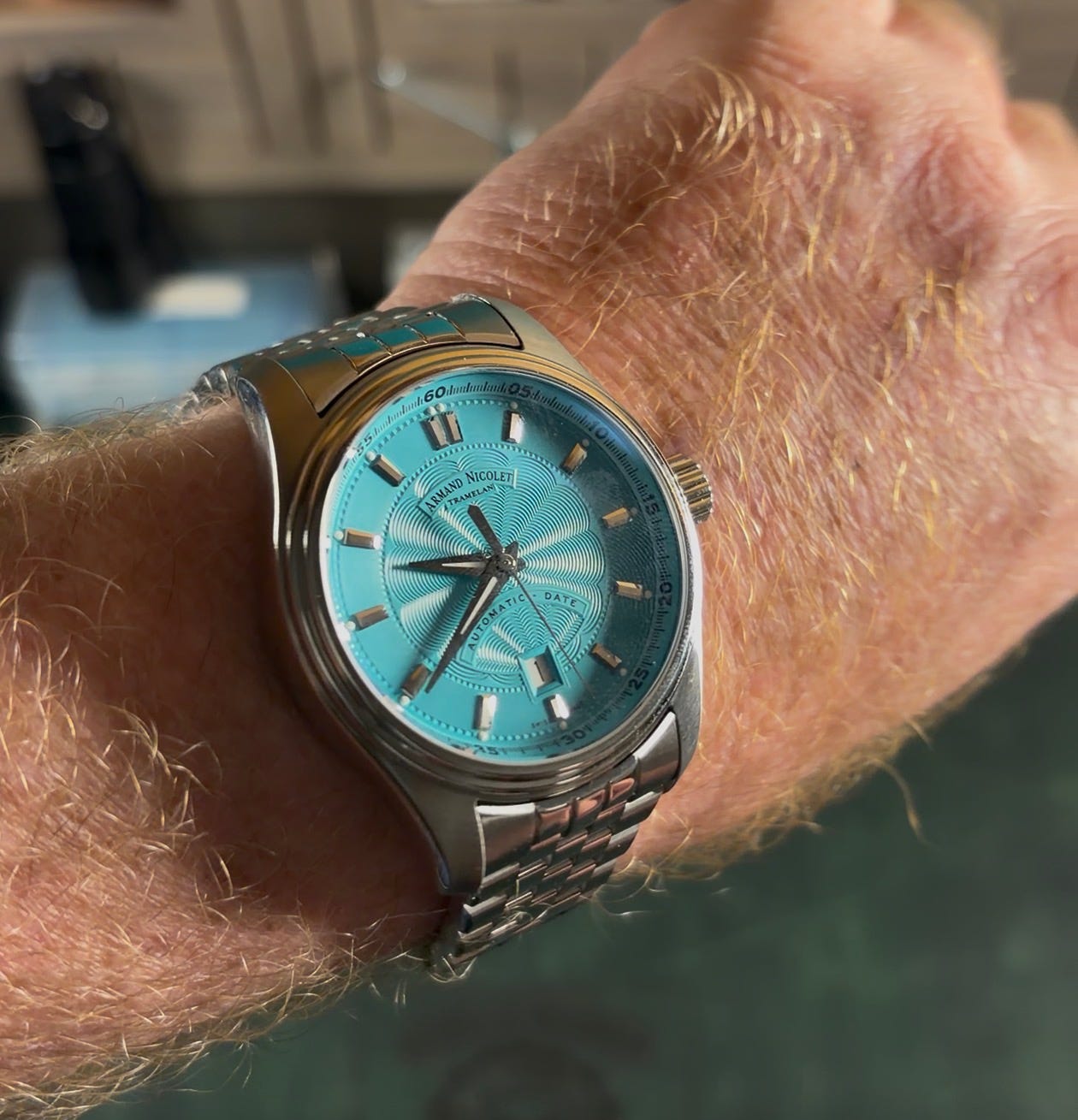
The Armand Nicolet was the one the watch people noticed.
There are always watch people on a ship if you know how to spot them, and they found the Armand Nicolet. That dial is hard to miss. It really pops, the acqua surfacing and receding depending on where the light comes from, and it pulled more unprompted conversation than anything else on my wrist. It earned its place in the bag through the talking rather than the timekeeping, which is its own kind of utility. A watch that starts conversations with strangers who care about watches is doing work the spec sheet does not list.
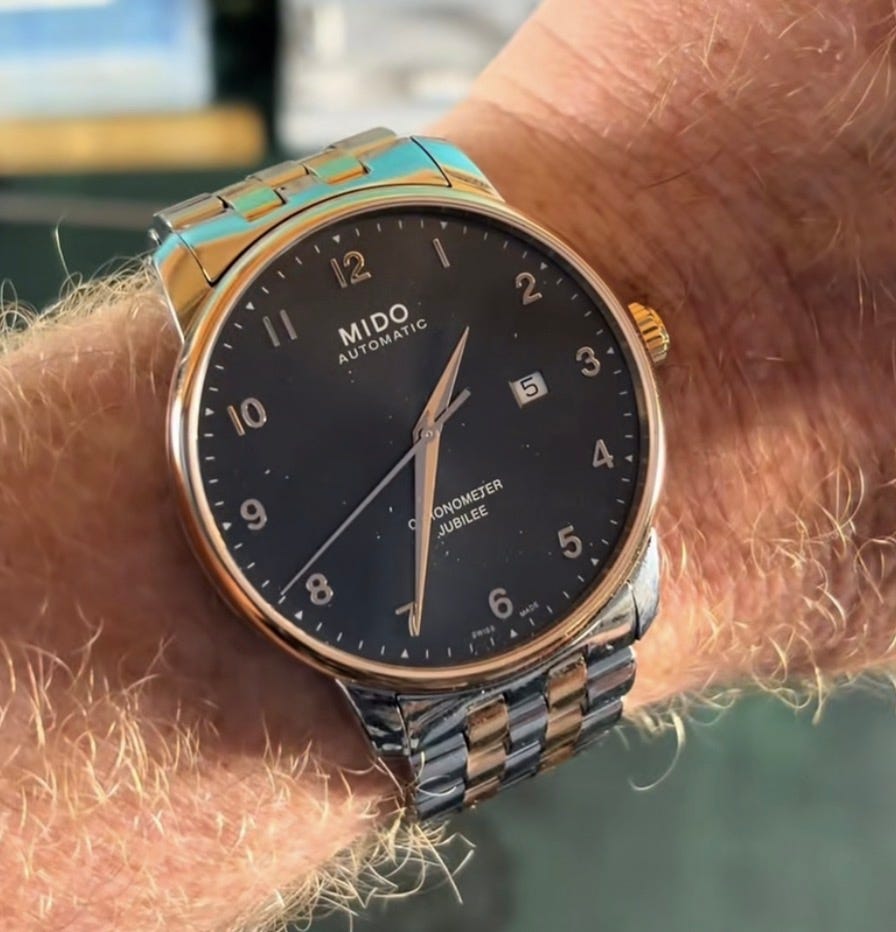
The Mido was almost too dressy for a trip that had no formal nights.
I bought the Baroncelli for formal dining rooms, and then it turned out there were no formal nights to speak of, at least not the way I had pictured them. What there was instead was The Hudson, the main dining room, where I wore the Mido twice with outfits built to match it. It delivered exactly the formality I asked of it, which on this particular family cruise was a touch more than the room strictly required. It still looked correct. It still drew compliments. It just taught me that the gap between dress and overdress is real, and that a ship’s idea of dressed up is calibrated differently than a Swiss boutique’s. Right watch, half a notch high, worn anyway and worn well.
The Citizen GPS read poorly, but it set easily.
The timezone watch was supposed to be the effortless one. Find a satellite, set itself, always know the local hour. In practice the automatic satellite lock was slower and less reliable than the pitch promised, and I ended up setting the timezone by hand for two of the four ports. To its real credit, the manual change was effortless, one click of the crown to push the hour forward or back, the easiest manual time zone adjustment I have used on any watch. The bigger problem was legibility. The dial and the hands share too much of the same color, and the contrast a watch needs to be glanceable at a dinner table simply was not there. It solved the problem it was bought for, mostly, while making me work to read the answer. A real limitation, named honestly, because the article that sold you on a watch should be the article that corrects the record.
The automatics ran down, and there was no good fix.
Here is the practical failure nobody plans for. I packed four automatics across the five slots, and you cannot wear four automatics at once. The ones that sat got no motion, and a watch that gets no motion winds down. I spent more of the trip resetting time and date on stopped watches than I expected to. I even went looking for a solution mid-trip, a travel watch winder that could keep four pieces running, and discovered that nothing like that exists in a travel package. Single and double travel winders are everywhere. A four-watch travel winder is apparently a problem the market has decided not to solve. So the automatics stopped, and I wound them, and stopped them again by not wearing them. Five automatics in a bag is four stopped watches and one running one, at any given moment.
The Ship Was a Watch Store I Did Not See Coming
I knew there would be a watch shop aboard. I did not know it would hold literally thousands of watches, an authorized dealer for Tissot, Hamilton, Longines, TAG Heuer, Oris, Breitling, Citizen, Bulova, and Invicta, with a sizable case of pre-owned Rolex on top of all of it. This was not a gift shop with a watch counter. This was a genuine retail operation floating in the Caribbean, and I spent more time in it than I will admit to Chrissy in writing.
Which is how the trip acquired two watches I did not plan for.
The Two I Did Not Plan
The one I won.
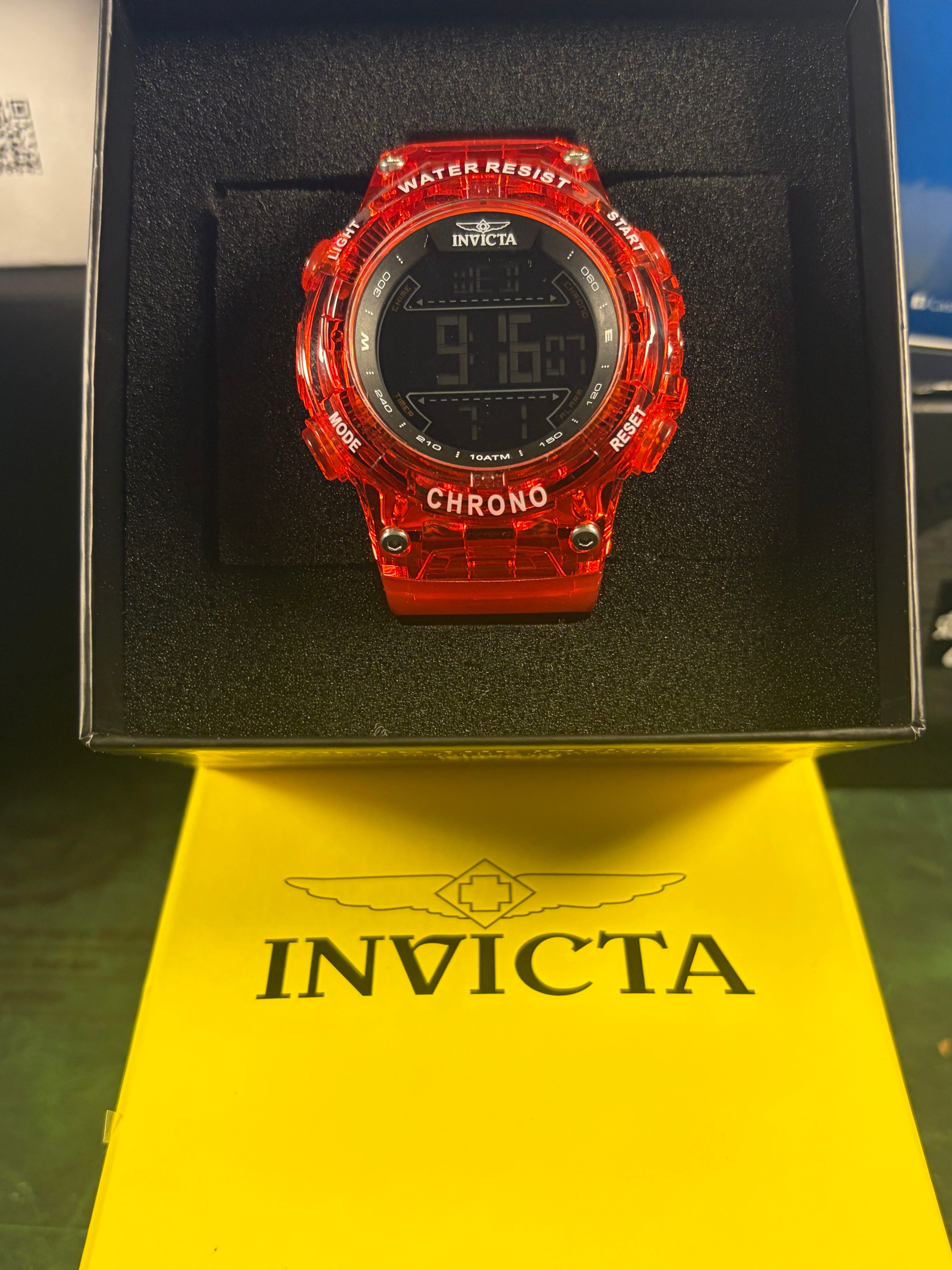
Fifty-two millimeters of transparent red plastic. A plastic dial under mineral crystal. A digital movement out of China. A polyurethane strap. The Invicta Racing Burnout Digital retails for fifty dollars, and I did not pay even that, because I won it in a raffle aboard the ship. It is, by every rule I have ever written down, exactly the kind of watch this collection exists to exclude. Battery quartz. No provenance. No research. No filter. Zero intentionality. It arrived by pure chance, the way a door prize arrives, with no story except the one it landed in.
The one she picked.
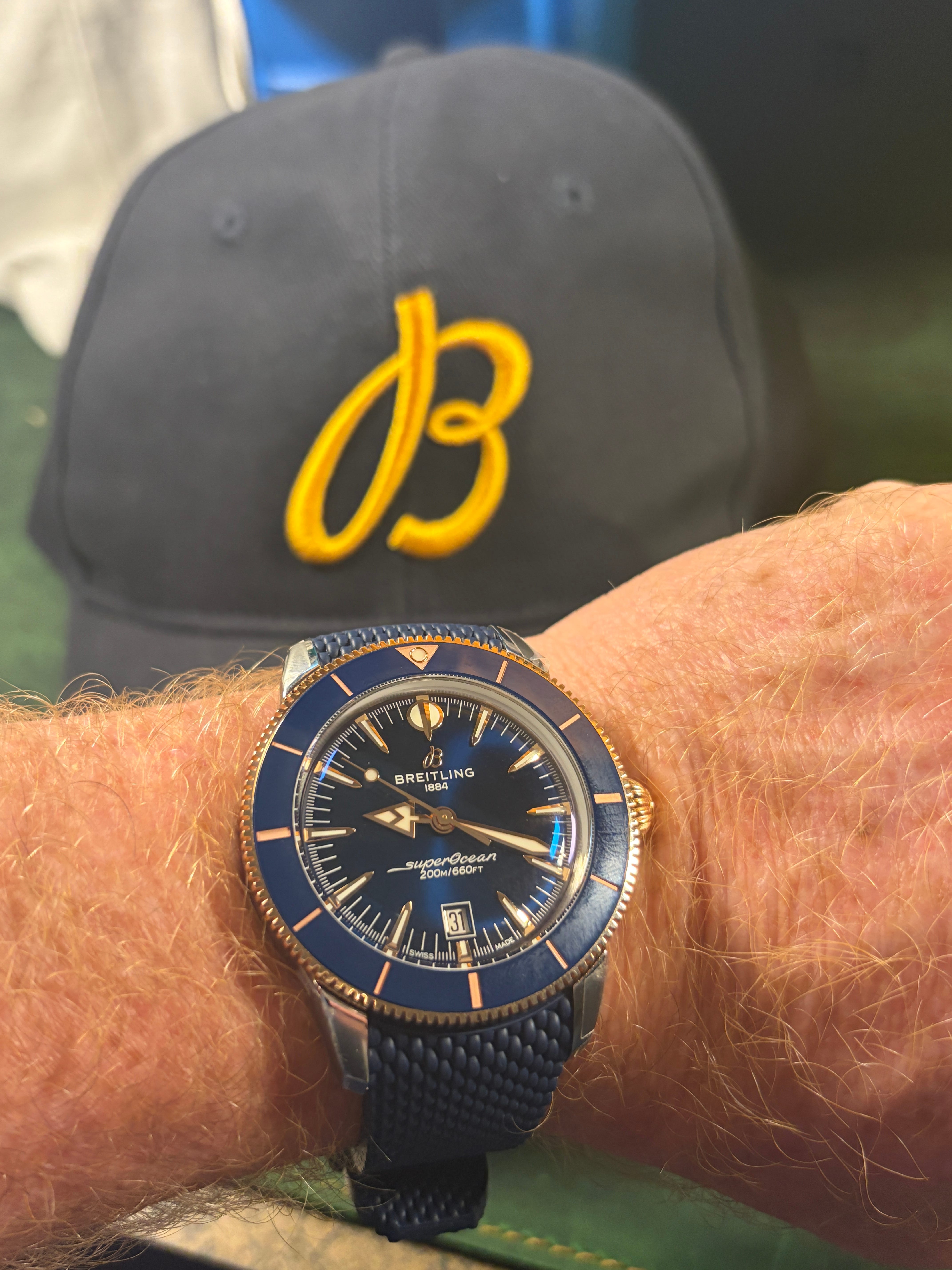
Chrissy chose the Breitling. I want to say that first, because it is the part that matters most and the part the standalone article is going to be about. The Superocean Heritage, rose gold and steel, blue dial, blue rubber strap, the B31 manufacture movement, two hundred meters of water resistance, picked up off the counter and handed to me by the person I was on the trip with. I could not say no. Not to the watch, and not to her. Duty free crossed the final T, the discount that turned a someday watch into a this-week watch.
There is a longer story here, about the watch I actually walked in to see, about how the Superocean was not even the Breitling I had been considering, about what it means that the most serious watch I own is the one piece my own filter did not choose. That story deserves its own room, and it is coming. For now it is enough to say the Superocean belongs, fully and without tension, and that it will always be this trip. The Norwegian Prima, my parents aboard, the twins newly graduated, Chrissy beside me. I will look at that blue dial forever and see June 2026. The provenance is the point. The watch is the door, and the room it opens is that week.
Later, in the lobby of the Prima Theater, a gentleman noticed the Breitling on my wrist and remarked that it was a really nice raffle gift. I laughed and told him the truth, that the fifty dollar Invicta was the raffle prize and I had bought the Breitling myself. We both had a good laugh about it. He was not wrong to be confused. On this trip, the watches arrived in exactly the reverse of the order the prices suggest.
What I Would Change
Hindsight is the whole reason to write one of these. Here is what the next bag looks like, corrected by the one that actually sailed. I am already thinking about it for the Margaritaville Beachcomber in April.
Fewer automatics. This is the big one. Four automatics in a five-watch bag meant a rotating cast of stopped watches and a lot of wasted setting. Two automatics maximum, and the rest light-powered or quartz, anything that holds its time sitting still. The grab-and-go category I have softened on for years is exactly the category a cruise rewards, because a watch that is right the moment you pick it up is worth more on a trip than a movement story you have to rewind. A Citizen Corso, black dial, luminous hands and markers, Eco-Drive so it never stops, leather strap, around three hundred and forty dollars, is precisely the kind of legible light-powered piece this bag was missing.
Straps, not bracelets. I did not expect this one. Between the walking, the water, and the drinking, my wrists swelled more than they do at home, and the metal bracelets stopped being comfortable by mid-afternoon. The FKM strap on the Oceaneva and the rubber on the Breitling, meanwhile, were perfect, forgiving when my wrist was at its largest and never once a problem. For April the rule is straps over bracelets, full stop. A swollen wrist on day four does not care how nice the bracelet looked on day one.
One dive watch, not two. The Navy and the Damascus and White did the same job, and only one of them needed to be there. The Damascus and White won on the strap and the versatility. Next time the Navy stays home and the slot it would have taken goes to something that fills a different need entirely.
A legible travel watch beats a clever one. The Citizen GPS was a neat trick that read poorly all of the time, even though it set easily by hand. For the next cruise the priority flips. I would rather have a watch I can read instantly at a dinner table than a watch that promises to set itself and then makes me squint to confirm it did. Legibility is the feature. Everything else is garnish.
The winder problem has a partial answer. Nobody makes a true four-watch travel winder, but there are compact units, like the small FRUCASE travel winders, that are not perfect and not built for four, yet are small enough to actually pack. Not a real fix. A hedge. The better answer is still the first one, pack watches that do not need a winder, but if I insist on bringing automatics that will sit, a compact winder is at least a thing that exists. The bag mostly solves the winder problem by not creating it.
Plan for the ship’s watch shop. I walked into a floating authorized dealer with no plan and no budget line for it, and I walked out having bought a Breitling I love. That worked out. It worked out because the Breitling was already on my roadmap and the occasion was real, not because walking in unprepared is a strategy. Next time I go aboard knowing what I would say yes to and what I would not, because a duty-free watch counter in the middle of the ocean is a very persuasive room.
What the Framework Was Actually For
I built this collection on rules. Non-plastic movements, the honest mechanical stuff, automatics and manual winds, no battery quartz on the roadmap. In-house manufacture. One per brand. An ascending path with a Patek at the far end of it. The rules are real and I am not abandoning them, because they did exactly what they were supposed to do.
But the cruise complicated the story, and I want to be careful about how I say this, because there is an easy version that is a lie.
The easy version says the rules were never the point, that underneath every filter was a single secret question, does this watch hold something true, and that both new watches pass it equally. That is too clean. It launders the Invicta into belonging, and the Invicta does not belong. It is a fifty dollar plastic digital watch that fails every standard I hold, and no amount of sentiment about a good week changes what it is. It is in the collection despite not belonging there. That is the honest sentence, and I am not going to soften it.
The Breitling is different. The Breitling belongs. It was on the roadmap, it is a serious watch, it was chosen by Chrissy on the trip of a lifetime, and it satisfies the rules and the meaning at the same time. There is no tension in the Breitling. It is exactly what the framework was built to acquire, arriving early and arriving beautifully.
So what do I do with a watch that fails every rule and that I am still never going to get rid of? I keep it, and I am honest about why. Not because it secretly qualified. Because it was there, in the room, the same week my parents were aboard and my sons were newly graduated and my partner was beside me. The rules decide what I buy. They do not get to decide what I am allowed to keep when chance hands me something that witnessed a week like that. The collection is mostly discipline. The Invicta is the one exception that proves the discipline was always in service of something the discipline cannot measure.
That is the more honest landing. The framework governs acquisition. It does not govern memory. And every so often a watch that should never have made it past the door ends up staying anyway, not because the rules bent, but because the rules were never the only thing in the building.
One More Thing, in Georgetown
In Georgetown, Grand Cayman, I walked into Kirk Freeport and saw a Patek Philippe Calatrava in person for the first time. The terminal watch on my roadmap, the one that sits at the end of a plan that runs to 2053, sitting in a case in front of me in the Caribbean. It was gorgeous in the way that only a thing you have been moving toward for decades can be gorgeous. I did not buy it. It is not time. But I have now seen the door at the end of the hallway, and it is exactly as worth walking toward as I believed it was.
In the same store I spoke with a Rolex sales associate whose mother, it turned out, lives in the same city as my parents. We talked watches and we talked home, two people from the same small corner of Florida standing in a duty-free shop on an island, finding the thread that connects everything back to the people the watches are really about. The collection is a memoir told through objects. Sometimes the memoir writes a line for you, in a jewelry store in Grand Cayman, about how small the world is and how the people stay at the center of it.
Five watches for seven nights was a good plan. The cruise improved it the way reality improves a plan, by ignoring the theory and keeping the truth. The watch I packed for a party I skipped carried the week. Two watches I never planned for came home, one that belongs and one that does not, and I am keeping both. And at the end of the hallway, seen for the first time in person, the watch I am still walking toward.
— Jaime
Precision on the wrist. Perfection in the glass. Music to feel. Stories that last.
bezelsandbourbon.com
Affiliate disclosure: I’m a proud Oceaneva affiliate. Use code BEZELS at oceaneva.com/bezels for 10% off your order. I earn a small commission at no additional cost to you. The affiliation followed the collection, not the other way around.