
I have rules about how I acquire things. Research before purchase. Write about the last one before you buy the next. One intentional acquisition per month. I have spreadsheets. I have roadmaps. I have a watch acquisition plan that runs to 2053.
I did not plan to own seven knives.
That’s not how it happened. There was no store, no rabbit hole, no afternoon of deliberate research that ended in a collection. Two people handed me something I hadn’t asked for, in a room I had earned the right to be in, and somewhere between the first knife and the second, the instinct woke up and started making decisions I hadn’t approved yet.
That’s the only kind of beginning that produces a real collection. The ones you plan turn into inventories. The ones that find you turn into something else.
December 2024. The end of a twelve-year road to third-degree black belt.
Chief Master David and Chief Master Laura Kowkabany are 8th-degree black belts in the American Taekwondo Association — an organization where 9th degree is Grand Master and the 10th will never be awarded again. Both of them have been offered the path to 9th. Both of them declined. They have one school, in Tampa, every class taught by their own hands for forty years. That choice — the mat over the institution, every time — is the context for everything they give and everything they withhold.
The curriculum at KFMA includes periodic clinics in gun and knife defense — taught to senior students, embedded in the testing requirements on the path to advanced rank. These are not electives. They are part of what the school considers complete training. I tested on knife defense technique on my way to fourth degree. When the Chiefs give a knife, they are not stepping outside the discipline. They are handing something from inside it.
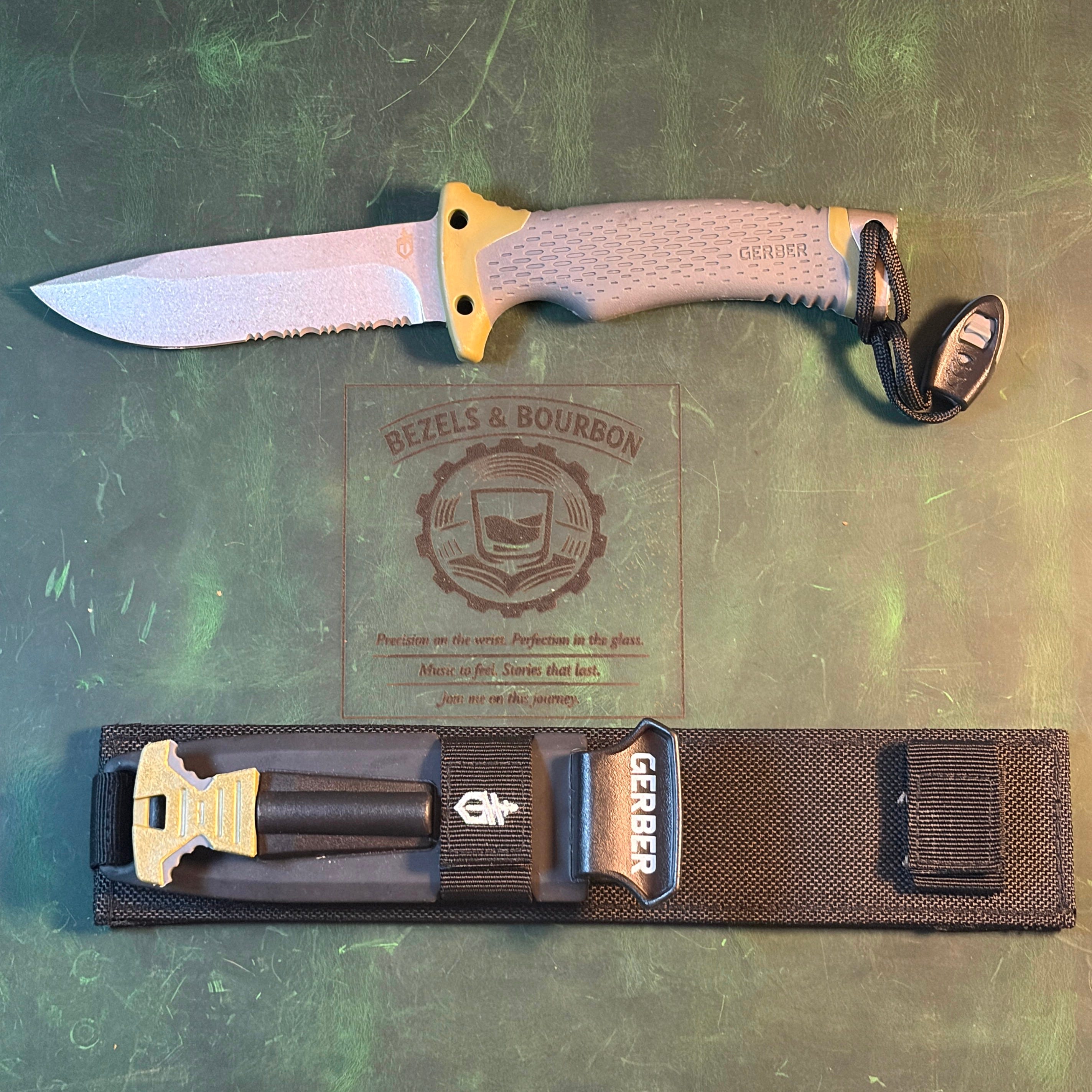
The gift that year was a Gerber Ultimate Fixed Blade. Four point eight inches of 7Cr17MoV high carbon stainless, textured rubber grip, a sheath engineered for situations where the knife is the last thing standing between you and a bad outcome — fire starter, whistle, diamond sharpener, all of it built in. It is a survival knife in the most literal sense. Not a display piece. Not a conversation starter. A tool designed to keep you alive when everything else has failed.
It was given privately. Both Chiefs. Three third-degrees. No audience beyond the people who had earned the right to be in the room.
I didn’t know then that it was the first of two.
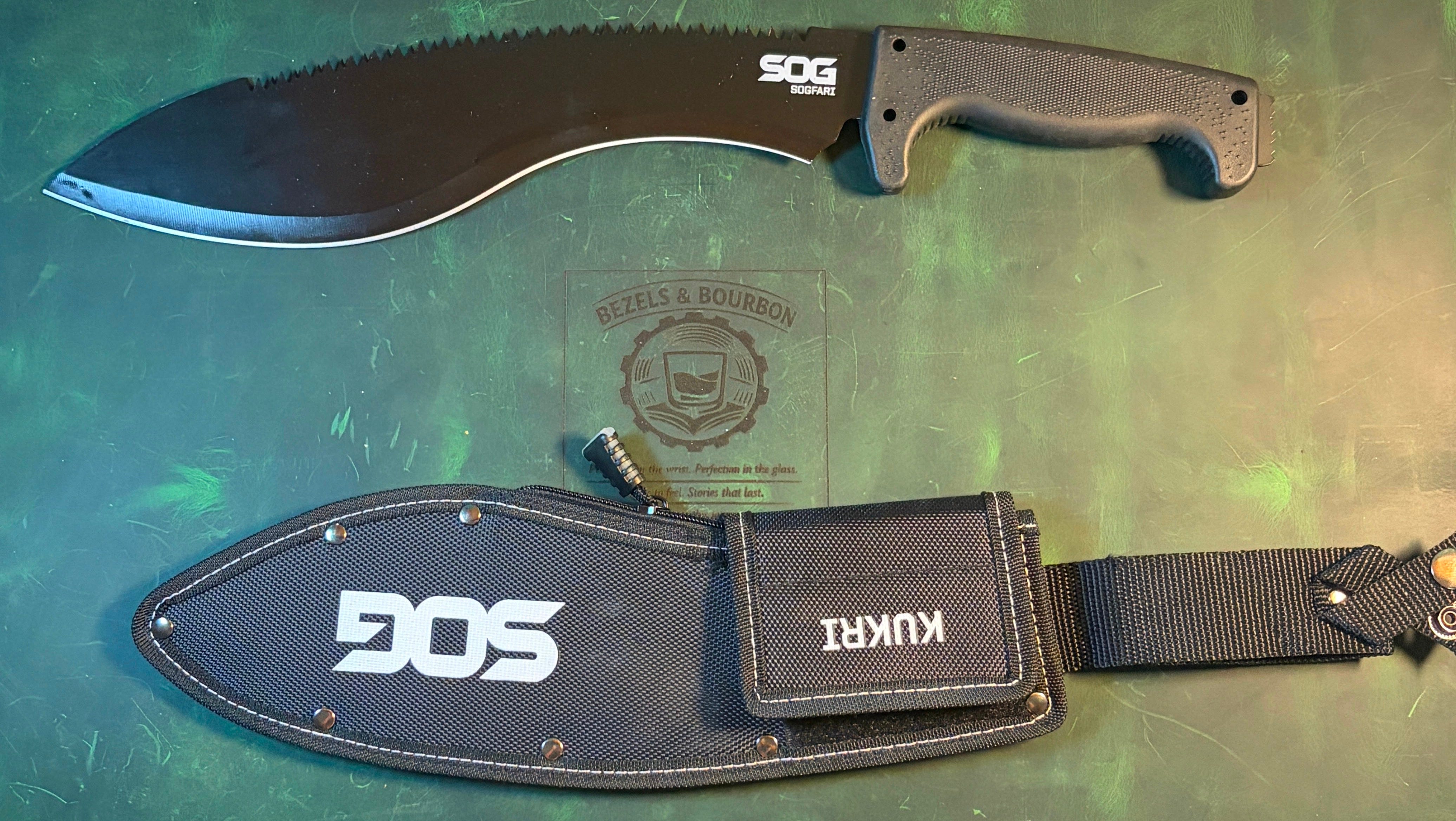
December 2025. The SOG Sogfari Kukri.
Twelve inches of blade. Eighteen inches overall. A double-cut sawback spine, a spiked tang built for pounding through whatever the path throws at you, a ballistic nylon sheath that suggests the knife was designed for forward motion. The Gerber asks: can you survive where you are? The Kukri asks something different. It asks: can you move through?
Same room. Same people. Same private moment.
I don’t know if the Chiefs planned the progression. I’ve never asked. But two knives, two years, one sequence — year one: here is what you need to survive; year two: here is what you need to advance — is not a coincidence. That is a philosophy. It comes from two people who have been teaching philosophy on a mat in Tampa for forty years, whether they call it that or not.
The Gerber and the Kukri are the anchor pieces. The collection exists because of them. Everything since is in conversation with what they started.
Before I knew I was building a collection, I had two knives that turned out to belong to one.
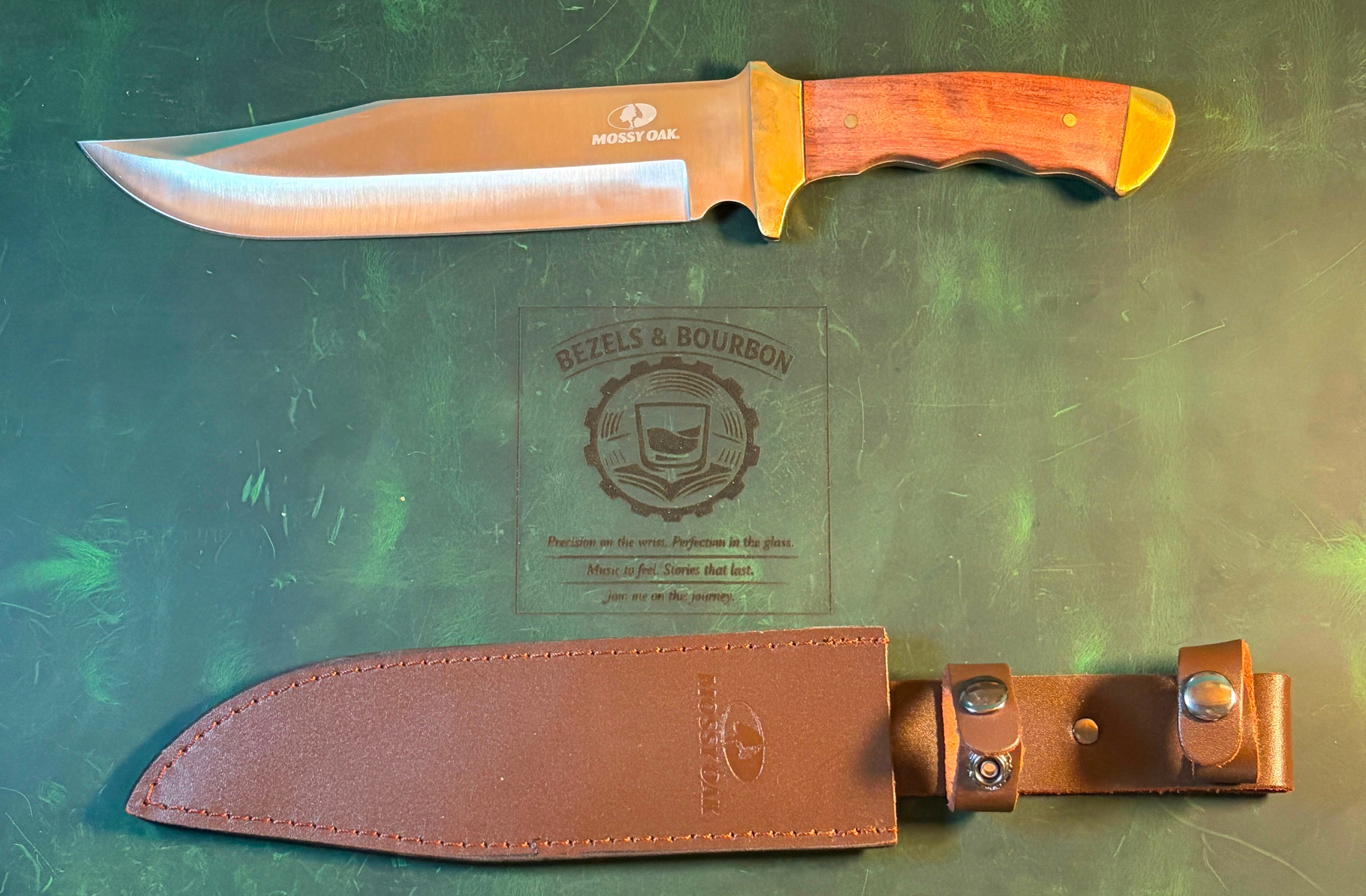
The Mossy Oak Bowie came in 2017 — eight and a half inches of blade, full-tang construction, brass handguard and pins, a rosewood handle that has darkened the way rosewood darkens when it’s been held enough times. It’s the oldest piece. It predates the collection as a conscious project by seven years, which earns it a particular kind of status: not quite an anchor piece, not quite a collection piece. A legacy piece. The thing that was already there when the framework arrived to make sense of it.
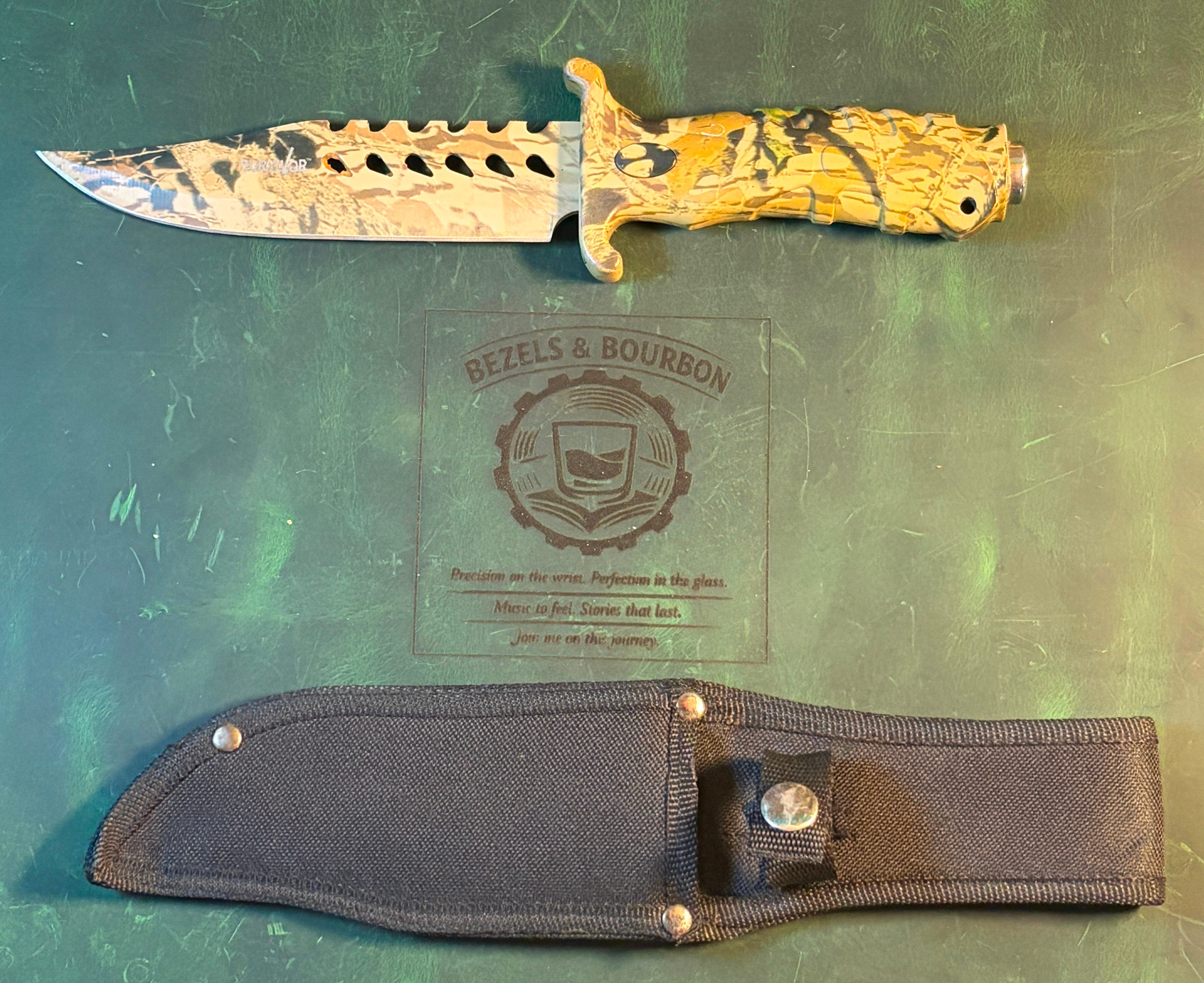
The Unlimited Wares HK-1037S came the following year. Camo pattern, sawback spine, hammer pommel, weight-reduction cutouts that give it the look of a knife designed by someone who took the brief seriously. Five ounces. Ten and a half inches overall. 3Cr13 stainless — the honest entry-level steel, the steel that tells you what a blade can be before you understand what the better steels are doing differently.
Neither of them is where the collection lives now. But they were there first, and they stayed, and that counts for something. In any collection built around objects that endure, the things that simply refused to leave deserve their place at the table.
A collecting instinct, once it’s awake, develops opinions quickly.
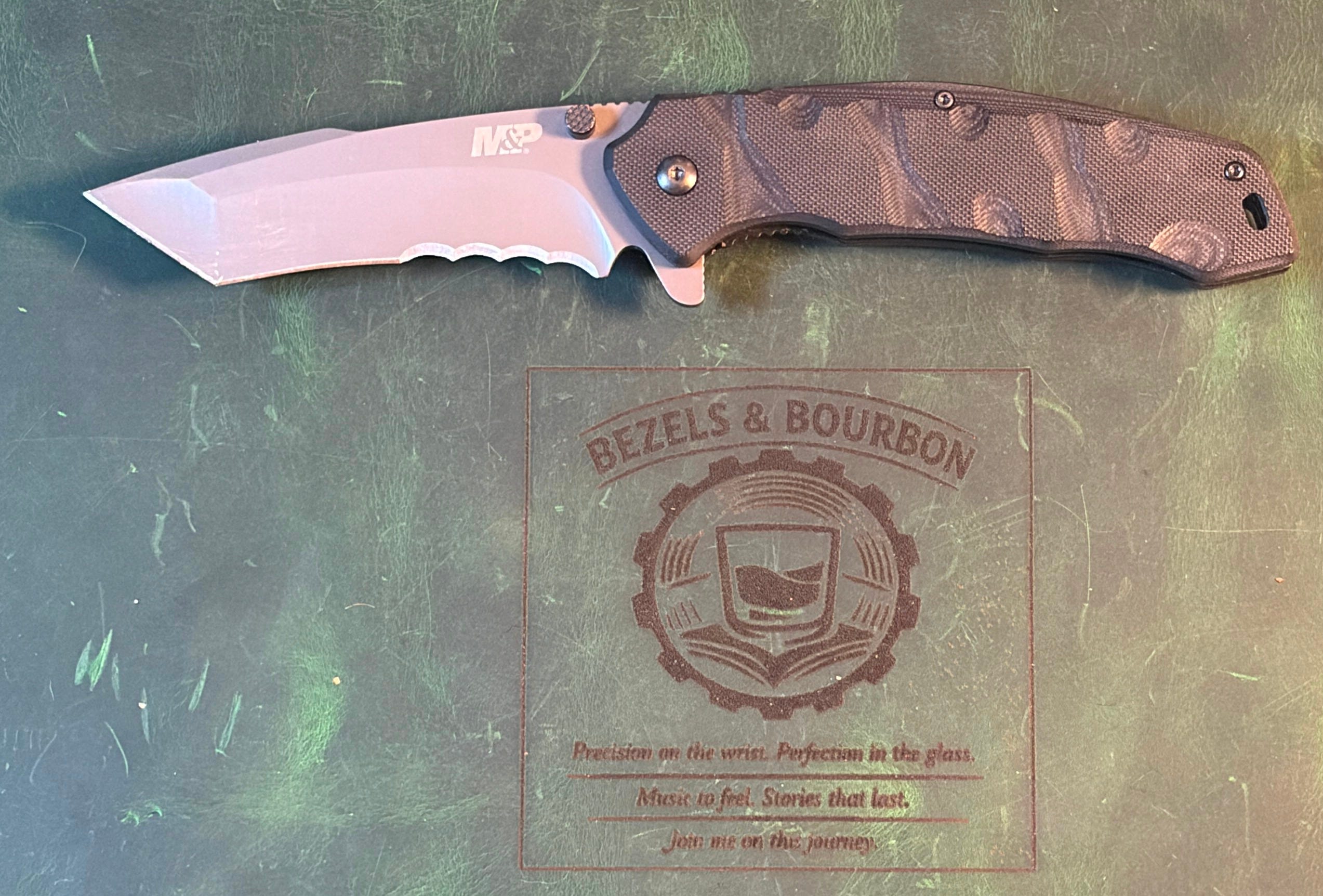
The Smith & Wesson M&P Special Ops folder came in 2025 and went immediately into the pocket, where it has been every day since. Spring-assisted, recurve Tanto blade, Veff-style serrations, G10 handle with enough texture to hold when the hand is wet or cold or moving fast. Two point nine seven inches of 8Cr13MoV — the step up from 3Cr13, the steel that starts to teach you what edge retention actually means. It is not a display piece. It is the carry. The knife that goes everywhere, the one that answers the question every serious collection eventually has to answer: if you could only keep one, which one? Right now, for me, it’s this one.
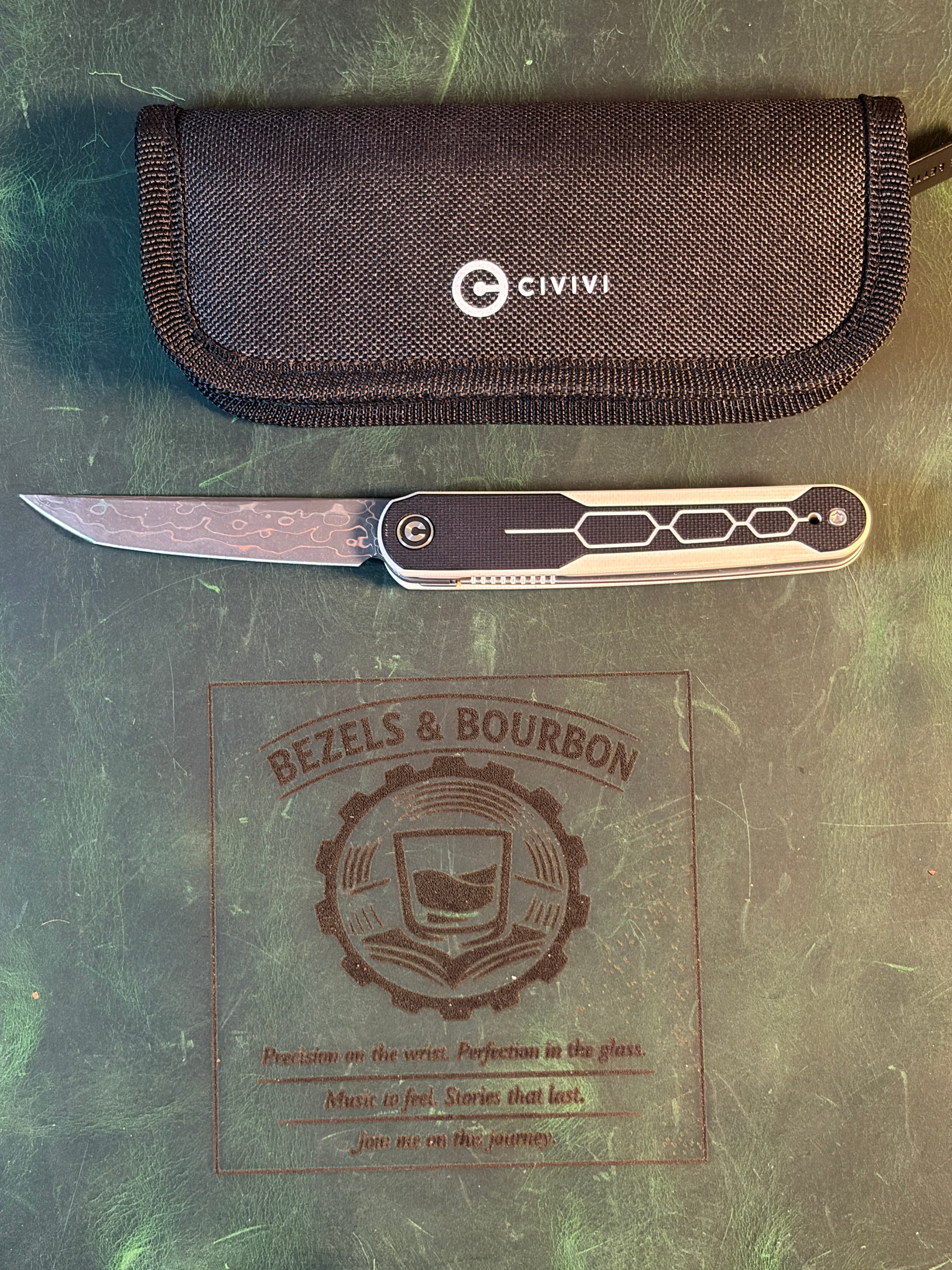
The CIVIVI KwaiQ arrived in 2026 and announced itself immediately as something different. Damascus Tanto blade, inline flipper, two point nine seven inches of folded steel that is, honestly, as much art as it is knife. Damascus steel is not the most practical choice — it requires more attention, more care, more awareness of what you’re doing with it. But there is a reason Damascus has been made for centuries, and looking at that blade, the reason is obvious. It is the most visually distinctive piece in the collection. It earns its place by being exactly what it is and not pretending otherwise.
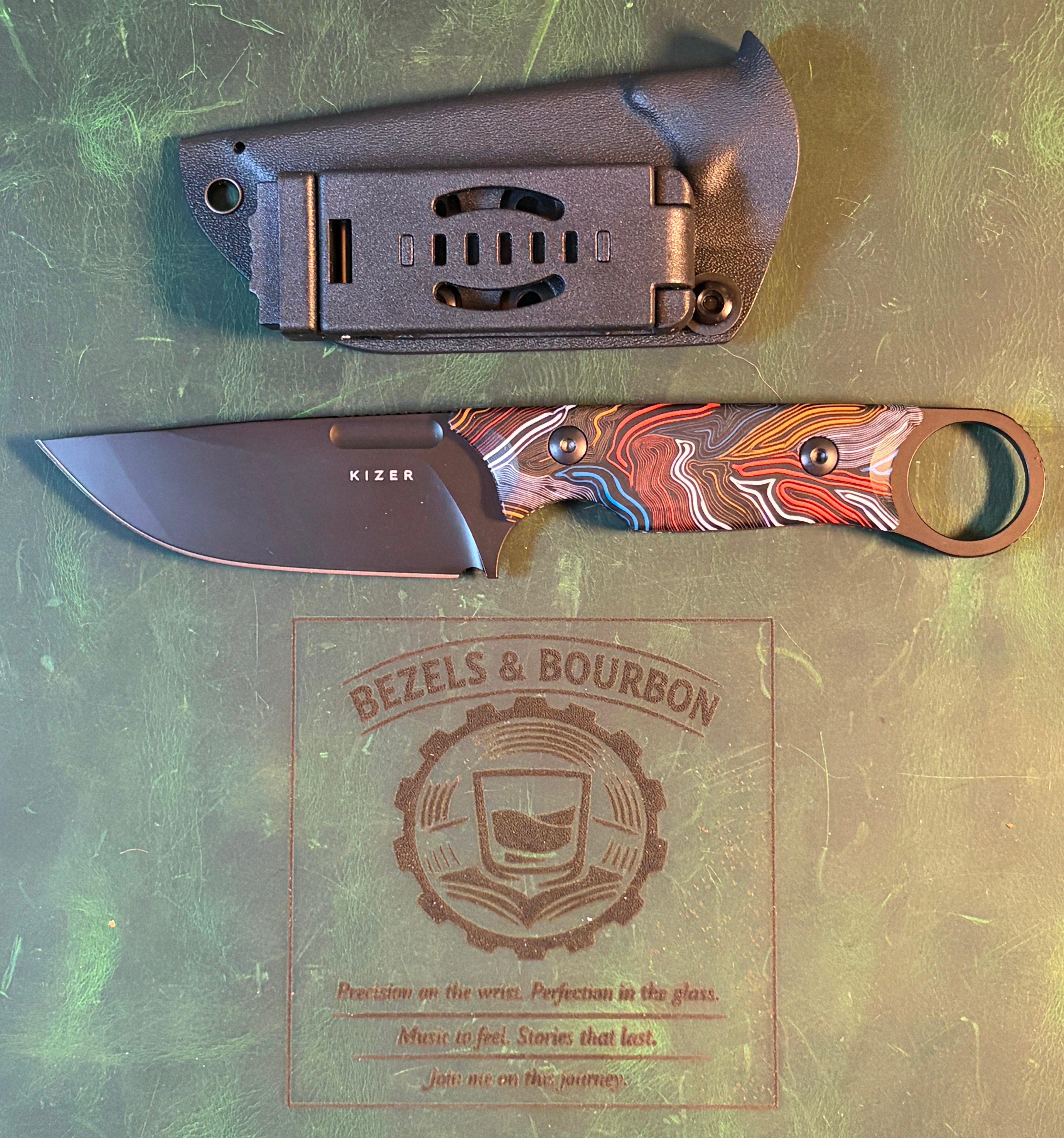
The Kizer Cabox 1048M1 is the argument for utility. D2 tool steel — hard, holds an edge at the cost of some corrosion resistance, the workhorse steel, the steel that doesn’t forgive inattention but rewards the collector who pays it. PVD coating, multicolored G10 handle, three point three six inches of blade in a compact fixed form built for scout carry. It is not romantic. It is excellent. Sometimes that’s the more important quality.
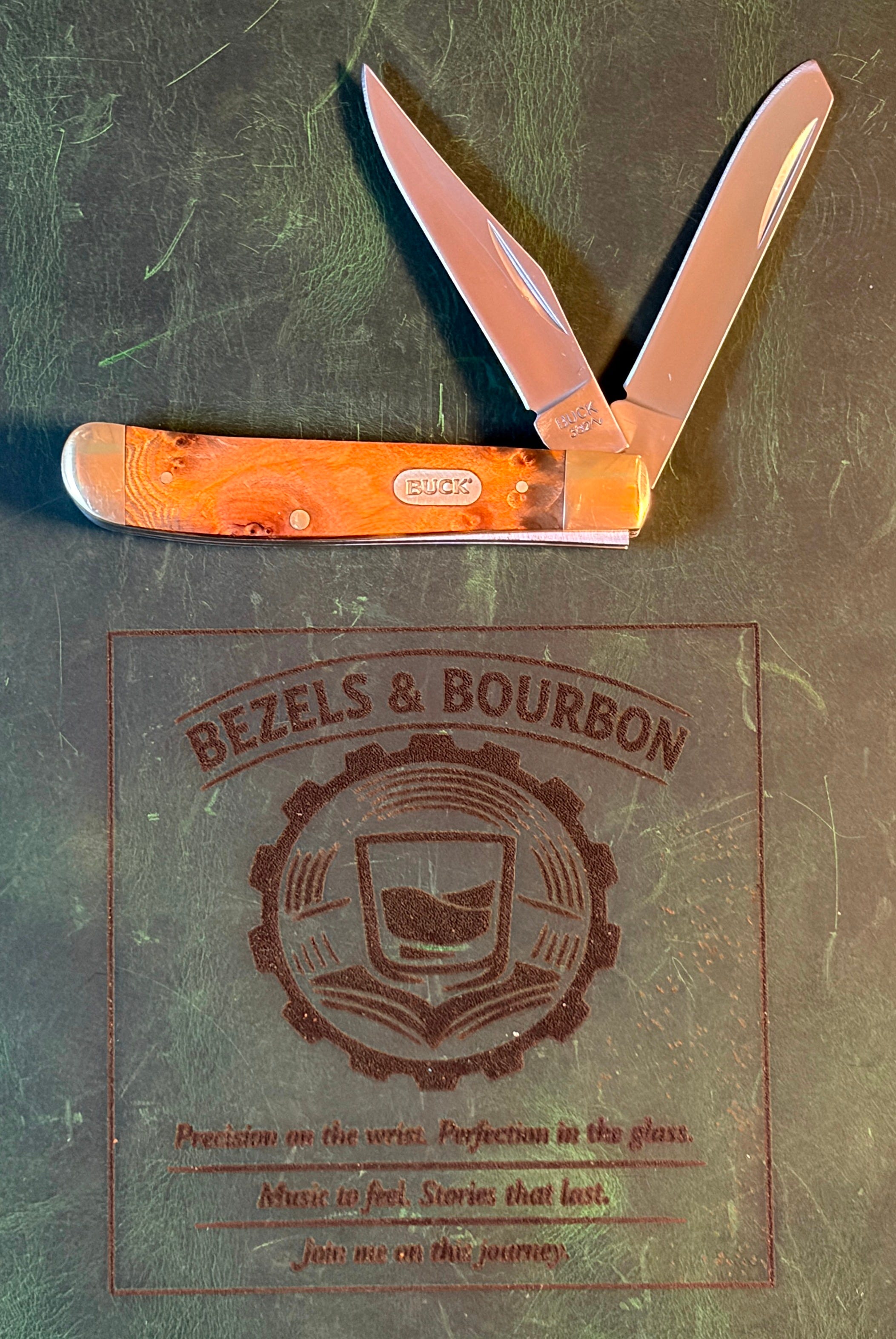
And then the Buck Knives 382 Trapper C, which is a conversation with a completely different tradition. Two blades — clip and spey — 420J2 steel, burlwood handle with nickel silver bolsters, six point one two five inches closed. A traditional American trapper pattern that has been made and carried and used and repaired for longer than most of the other steels in this collection have existed. The Buck doesn’t belong to the same world as the Gerber and the SOG. It belongs to an older world, one where a folding knife was a daily working tool that a man carried until it wore out and then replaced with the same pattern because the pattern was right. I added it because a collection that only speaks one language isn’t really a collection. It’s a preference list.
The collection lives on a green leather mat in my study — B&B embossed in the surface, the logo pressed into the leather the way anything worth keeping eventually earns its mark. The loupe is there. The strap tools. The bourbon glass in the corner of the frame. It is the same surface where watches get opened and evaluated and understood, and it turns out to be exactly the right surface for blades too. Some things belong together because they share a philosophy, not because they share a category.
The Gerber and the SOG are already there. The carry is in the pocket. The legacies have found their place.
The display is still an open question. The larger fixed blades want a different solution than a case — one that accounts for sheaths, for scale, for the difference between showing a knife and housing it correctly. I haven’t found the right answer yet. I’m not going to settle for the wrong one.
That’s not an admission of incompleteness. That’s the collection being honest about where it is. The Chiefs spent forty years not settling for the institutional path when they knew the mat was the right one. The least I can do is extend the same patience to the question of how to display what they gave me.
The anchor pieces are home. The philosophy is clear.
The rest will follow when it’s ready.
— Jaime